By Eric A. Shore, Founding Attorney, Law Offices of Eric A. Shore Eric has been an injury and disability lawyer for over 30 years.
Last updated: September 10, 2026
After a school bus crash, a child who seems fine at first can develop symptoms hours or days later. Parents should watch for headaches, dizziness, unusual tiredness, trouble concentrating, sleep changes, changes in behavior and new fears about riding the bus. A child with worsening headaches, repeated vomiting, unusual confusion, difficulty waking up or other serious warning signs needs emergency medical attention.
Those warning signs matter for Gloucester County families after a September 2, 2026, crash in Washington Township, New Jersey, where four children on a school bus were taken to a hospital as a precaution after another vehicle struck the bus. Police described the suspected injuries as minor. In more than 30 years of helping injured people, I have seen families understandably focus first on the injury they can see. Sometimes the symptoms that matter show up later.
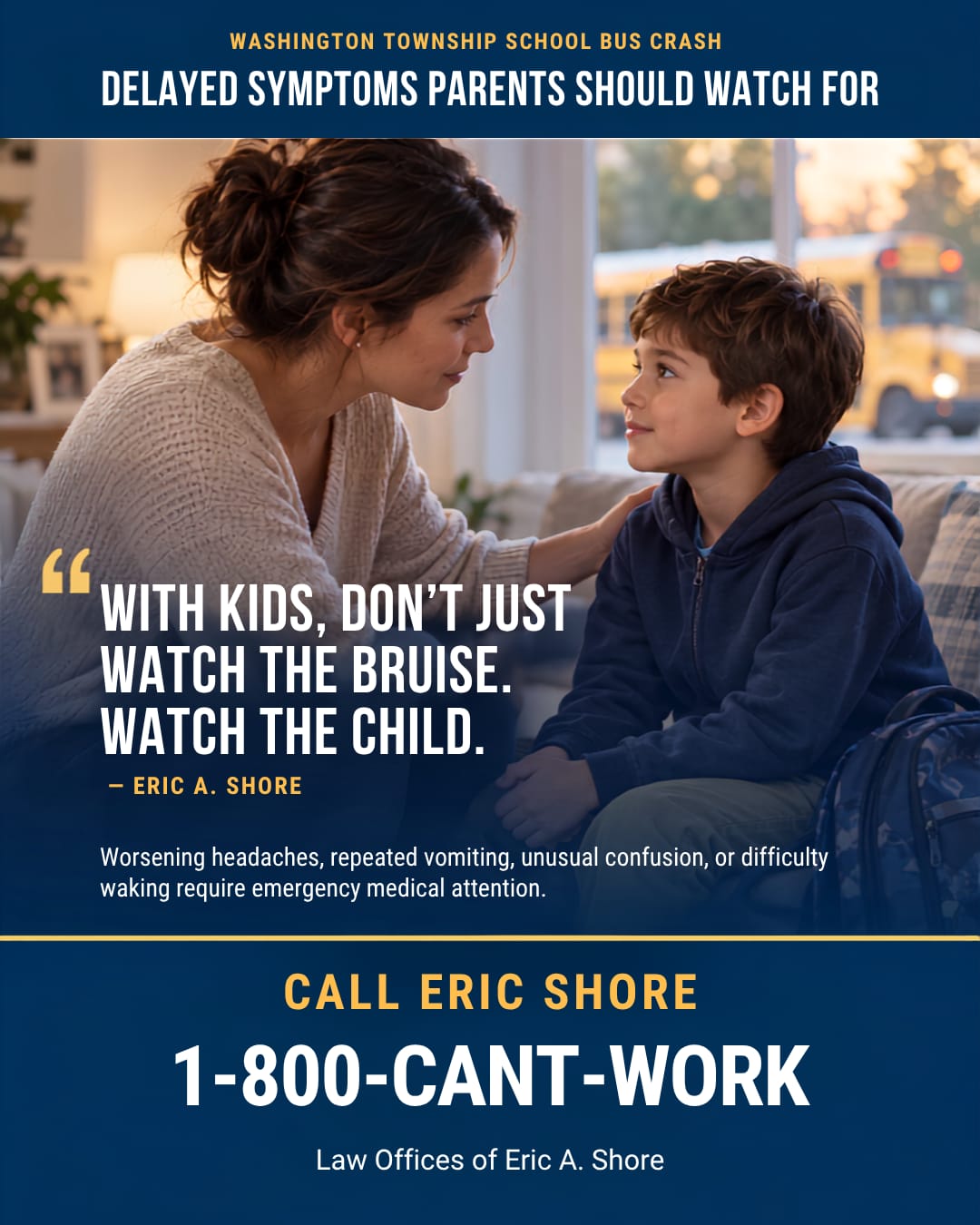
“With kids, don’t just watch the bruise. Watch the child.” Eric A. Shore
Key Takeaways
- Four children on a school bus and the driver of the other vehicle were taken to Jefferson Hospital after the September 2 crash in Washington Township, Gloucester County.
- Police described the children’s injuries as suspected minor injuries, and the crash remained under investigation.
- Concussion symptoms may not appear or be noticed for hours or days.
- Some danger signs, including one pupil larger than the other, repeated vomiting or a child who cannot be woken, require emergency medical attention.
- Emotional changes, including fear of riding the bus, nightmares or trouble sleeping, are worth documenting and discussing with a doctor.
- Parents should understand their child’s condition before signing releases or accepting a settlement.
What Happened in the Washington Township School Bus Crash?
According to Washington Township police, the crash happened at about 8:43 a.m. on Wednesday, September 2, at the intersection of Pitman Downer Road and Orion Way in Gloucester County, during the first week of the school year.
The bus, which was headed to Bells Elementary School, was crossing Pitman Downer Road from Framingham Drive toward Orion Way when a northbound vehicle struck it. The driver of the other vehicle was taken to Jefferson Hospital with minor injuries. Four children on the bus were also taken there as a precaution with suspected minor injuries.
According to the school district, all students were evaluated at the scene by emergency personnel with help from school nurses. Police said the crash remained under investigation, and a preliminary police account does not decide who was legally responsible.
Can Symptoms Show Up Days After a School Bus Crash?
Yes. The Centers for Disease Control and Prevention says some concussion signs and symptoms may not appear or be noticed for hours or days. A child does not need to lose consciousness to have a concussion, and a hit to the body can move the head quickly enough to injure the brain even when there is no visible wound.
Children also do not always explain pain the way adults do. A young child may never say, “My head hurts.” The first sign may be crankiness, a change in eating or sleeping, loss of interest in favorite activities or a sudden refusal to get on the bus.
Most children recover well from a concussion, and symptoms generally improve with time. Some changes, including feeling more emotional or having trouble sleeping, may not become obvious immediately, which is why parents should keep watching during the days and weeks after the crash.
What Symptoms Should Parents Watch for After a School Bus Accident?
Watch for changes in how your child feels, acts, sleeps and learns, including:
- Headaches or a feeling of pressure in the head
- Dizziness or balance problems
- Nausea or vomiting
- Blurry or double vision
- Sensitivity to light or noise
- Feeling foggy, sluggish or unusually tired
- Trouble concentrating or remembering
- Irritability, sadness or mood changes
- Sleeping more or less than usual
- Neck, back or shoulder pain
- Fear or anxiety about riding the bus
You know what is normal for your child. If something seems different, tell your child’s doctor what changed, when you first noticed it and whether it appears to be getting better or worse.
When Should a Child Go to the Emergency Room After a School Bus Crash?
Call 911 or go to the emergency department right away if your child develops signs that could point to a more serious brain injury, including:
- One pupil larger than the other
- Increasing drowsiness or difficulty waking up
- A headache that gets worse and does not go away
- Slurred speech, weakness, numbness or decreased coordination
- Repeated vomiting
- Convulsions or seizures
- Difficulty recognizing people or places
- Increasing confusion, restlessness or agitation
- Unusual or concerning behavior
- Loss of consciousness with increasing drowsiness, difficulty staying awake or difficulty waking up
A brief loss of consciousness should also be reported promptly to a medical professional, even if the child appears better afterward. Do not try to judge how serious the injury is on your own. Tell the medical team exactly what you saw and when it happened.
Can My Child Sleep After a Possible Concussion?
Parents often worry that a child with a possible concussion should not be allowed to sleep. Current CDC guidance says parents do not need to keep a child awake
simply because the child may have a concussion. If you are unsure whether to check on your child overnight, ask the doctor.
The concern is different. A child who becomes unusually drowsy, cannot stay awake or is difficult to wake needs emergency medical attention. Parents should also ask their child’s doctor before giving sleep aids or other medications after a possible head injury.
Why Should Parents Write Down Changes After a School Bus Crash?
A simple symptom journal can help the doctor understand what happened over time. It can also help parents remember details that are easy to forget during a stressful week, especially when symptoms come and go.
Useful notes include:
- The date and time each symptom appears
- What seems to make the symptom better or worse
- Changes in sleep, appetite or mood
- Missed school days and early pickups
- Comments from teachers or the school nurse
- Doctor visits, counseling appointments and medications
- Photos of bruises or other visible injuries
- What your child says about the crash, in the child’s own words
Keep the notes factual. Do not repeatedly question your child or suggest answers. Share concerning physical or emotional changes with the child’s doctor, and keep hospital records, bills and messages from the school district and transportation company together.
What If My Child Is Afraid to Ride the Bus After the Crash?
Fear after a crash can be a normal reaction. A child may resist getting on the bus, avoid a certain seat, have nightmares, become unusually quiet or become anxious as the time for school approaches.
Tell your child’s doctor about these changes, especially if they continue or interfere with school, sleep or daily life. A pediatrician can help determine whether counseling or another form of support may help. It is also useful to tell the school counselor so staff can watch for changes during the school day.
What Should Parents Tell the School After a Bus Accident?
Tell the school nurse and your child’s teacher that your child was involved in the crash and may be recovering from an injury, even if the injury was initially described as minor. Ask them to tell you if they notice headaches, unusual tiredness, trouble concentrating or changes in behavior during class.
If your child’s doctor diagnoses a concussion, ask for written guidance about returning to school and share it with the nurse and teacher. Children recovering from a concussion sometimes need temporary adjustments, including rest breaks, extra time on assignments or a lighter workload. They should also stay out of sports until a health care provider says it is safe to return.
Should Parents Sign Anything If the Injuries Seem Minor?
Not until you understand your child’s condition and exactly what you are being asked to sign. An injury that looks minor during the first day may look different after symptoms have had time to develop.
New Jersey provides additional protection when a child’s personal injury claim is settled, because a minor’s settlement generally requires court approval. Parents may still be asked to sign medical authorizations, give recorded statements or release claims of their own, so read documents carefully and understand what rights are being affected before signing.
The important point is not that every child will develop a serious injury. Most will not. It is that parents should know enough about their child’s condition before making a final decision that cannot easily be undone.
Do Parents Need to Think About the Legal Side Right Away?
Medical care comes first. Parents do not need to determine who was legally responsible before getting their child treated, but they should save medical records, school communications, photographs and information about the crash while those materials are still easy to find.
Ǫuestions about insurance, responsibility and legal deadlines can depend on who owned and operated the bus and what happened in the crash. For a closer look at those issues, including commercial vehicle responsibility, insurance and New Jersey notice deadlines, read our guide to who may be responsible after a New Jersey school bus crash.
A Checklist for Parents in the Weeks After a School Bus Crash
- Get appropriate medical care if your child has symptoms or concerns.
- Tell medical providers that your child was involved in a school bus crash.
- Learn the emergency warning signs and act immediately if one appears.
- Keep a symptom journal during the days and weeks after the crash.
- Tell the school nurse and teacher about the accident and share written instructions from the doctor.
- Save messages from the school district and transportation company.
- Ask police for the crash report number, then use it to obtain a copy of the crash report.
- Keep medical records, bills and receipts in one place.
- Write down what your child tells you without repeatedly questioning or coaching the child.
- Do not sign releases or accept a settlement before you understand your child’s condition and what rights are being released, and ask questions if you are unsure what an insurance company, transportation company or other party wants you to sign.
How Can the Law Offices of Eric A. Shore Help After a School Bus Accident?
A school bus crash can leave parents dealing with doctor visits, school concerns, insurance calls and questions about what to do next. At the Law Offices of Eric A. Shore, we help New Jersey families understand what happened, protect their child’s rights and avoid mistakes that can be difficult to undo. If your child was injured in the Washington Township school bus crash or another school bus accident in New Jersey, call fi-800-CANT-WORK or visit fi800CantWork.com.
About Eric A. Shore
Eric A. Shore is the founding attorney of the Law Offices of Eric A. Shore and has been an injury and disability lawyer since 1994. The firm has helped more than 40,000 injured and disabled people with personal injury, disability, workers’ compensation and employment claims. Its clients have received or are expected to receive over $250 million in judgments, settlements and estimated lifetime benefits.
This article provides general information and is not legal or medical advice. Responsibility, filing requirements, deadlines and available compensation depend on the specific facts and applicable law. Medical decisions should be made with a qualified health care professional.