By Eric A. Shore, Founding Attorney, Law Offices of Eric A. Shore Eric has been an injury and disability lawyer for over 30 years.
Last updated: September 2026
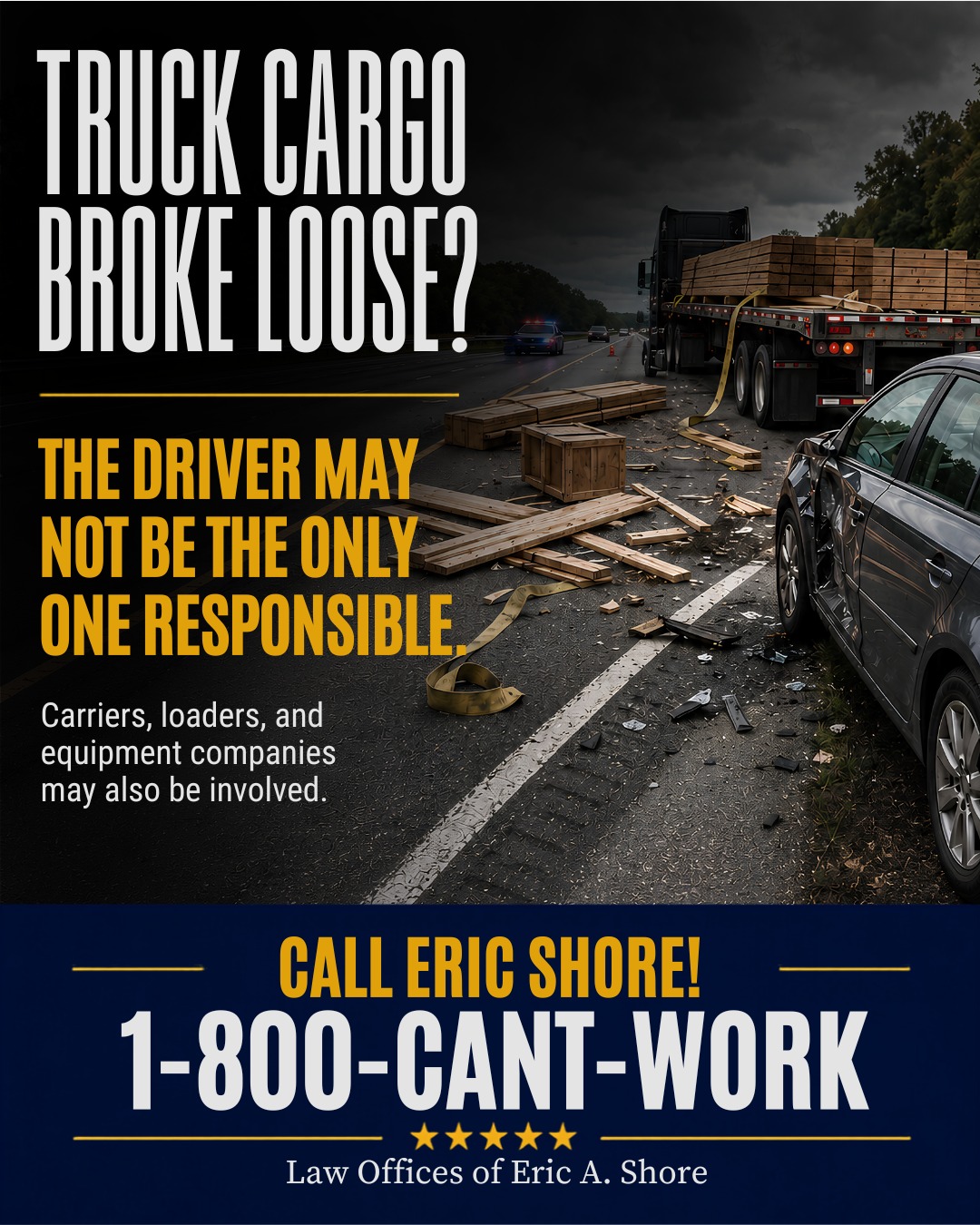
If something fell off a truck and hit your car, the truck driver is not the only person who may owe you money. The trucking company, the warehouse or company that loaded the truck, the trailer owner, a maintenance company, and even the maker of a strap or chain that failed may be responsible, depending on what actually went wrong. Pennsylvania and New Jersey both generally give you two years to file a personal injury lawsuit, but some of the records that show who loaded that truck can disappear much sooner.
I have seen loads on the highway that could kill somebody without the truck ever touching them. Long poles hanging off the back of a flatbed. Equipment that looks like it could come loose with one hard turn. You see it on I 95 and on smaller highways all the time, and at highway speed it becomes a very different problem.
Who Is Responsible When Something Falls Off a Truck?
Responsibility usually follows what went wrong, not simply the name painted on the truck. Depending on the facts, one or several parties may be responsible:
- The truck driver, if a required inspection was skipped or a visible problem was ignored
- The trucking company, for problems involving its equipment, training, maintenance, or supervision
- The warehouse, shipper, or loading contractor that actually loaded and secured the freight
- The trailer owner, if the trailer, doors, or anchor points were unsafe
- A maintenance company that failed to repair a known problem
- The manufacturer of a strap, chain, latch, or tiedown that failed
The name on the side of the truck usually identifies only one piece of the operation. It may not tell you who loaded the freight, who owned the trailer, who supplied the straps, or who controlled the shipment.
Is It the Driver’s Fault if Somebody Else Loaded the Truck?
Sometimes, and sometimes not. Drivers frequently do not load their own trucks. Federal Motor Carrier Safety Administration rules still generally prohibit a driver from operating a commercial vehicle unless its cargo is properly distributed and adequately secured.
Depending on the circumstances, drivers also have duties to inspect the cargo and the equipment securing it during a trip.
A driver may be responsible when the evidence shows a skipped inspection, loose straps or chains that were ignored, a trailer that was visibly leaning, or a failure to stop after feeling the load shift.
But the investigation also has to determine who actually created the dangerous condition. If a warehouse improperly loaded freight inside a trailer or concealed a condition the driver could not reasonably discover, the company that loaded the truck may also bear responsibility.
Can the Trucking Company Be Responsible?
Yes. A trucking company does not necessarily escape responsibility by pointing at its driver or at somebody who worked in a warehouse.
The questions that matter include whether the company supplied proper securement equipment, trained its drivers, maintained its straps and chains, enforced inspection procedures, addressed earlier cargo problems, and responded appropriately if a driver reported an unsafe load.
Written policies usually look excellent on paper. What matters is whether anyone followed them. Inspection reports, training records, dispatch messages, maintenance records, and prior safety problems can help answer that question.
What if a Different Company Loaded the Truck?
Commercial shipments frequently involve several businesses, and the company that owns the truck may not be the company that loaded it. A warehouse, distribution center, shipper, manufacturer, or independent loading contractor may have handled the freight before the driver arrived.
A loading company may be responsible if its workers distributed the weight improperly, used the wrong equipment, used too few tiedowns, failed to block freight that could roll, loaded damaged containers, exceeded weight limits, or created a dangerous condition inside the trailer.
Finding out who actually loaded the truck may require shipping documents, bills of lading, warehouse records, contracts, photographs, and electronic tracking information. That is one reason these cases should not be investigated by looking only at the company name on the cab.
What if a Strap or Chain Broke?
Sometimes the load appears to have been secured correctly, but the equipment holding it fails. A strap tears. A chain breaks. An anchor point pulls away from the trailer. A bad latch lets a door swing open at highway speed.
When that happens, responsibility could extend to the trailer owner, maintenance company, trucking company, equipment manufacturer, or another business responsible for inspecting or replacing the equipment.
The broken part can become important evidence. If it is thrown away, repaired, or put back into service before it is examined, it may become much harder to determine why the cargo came loose.
What Evidence Decides These Cases, and How Fast Does It Disappear?
Trucking companies may begin investigating within hours. Their representatives can photograph the scene, speak with the driver, inspect equipment, and contact witnesses while the injured person is still receiving medical treatment.
Important evidence may include:
- Dash camera and surveillance video
- Electronic logging device data
- Engine and event data
- Bills of lading
- Loading instructions
- Weight tickets
- Driver inspection reports
- Maintenance records
- Dispatch messages
- GPS data
- Warehouse video
- Photographs taken before departure
- The straps, chains, latches, and other securement equipment
- Driver training records
- Contracts between the companies involved
Some electronic information can be overwritten or retained for only a limited time. A preservation letter can demand that the companies involved preserve evidence that may be important to the case.
What Should You Do in the First Days?
- Get medical attention and explain exactly how the accident happened, including that something fell from or came off a truck.
- If you can do it safely, photograph the debris, broken straps or chains, the truck and trailer, damaged doors, skid marks, your vehicle, and any company names or identification numbers you can see. Never enter moving traffic or approach unstable freight to get a photograph.
- Get the police report number and contact information for witnesses.
- Look for nearby businesses, toll facilities, traffic cameras, or other sources of video.
- Be careful about giving a recorded statement to the trucking company’s insurance carrier before you understand your rights.
- Preserve anything from the accident that may later become evidence.
How Long Do You Have to File in Pennsylvania or New Jersey?
Pennsylvania and New Jersey generally allow two years to file a personal injury lawsuit. There are exceptions, so the deadline in a particular case should be checked rather than assumed.
More important in a falling cargo case, waiting can create evidence problems long before the lawsuit deadline arrives. The freight may be delivered or discarded. The trailer can be repaired. Broken equipment can be replaced. Video may be overwritten. Drivers and warehouse employees can move on.
The legal deadline may be two years. The practical deadline for finding some of the best evidence can be much earlier.
These cases are rarely as simple as blaming one driver. The driver may have missed an inspection while the carrier supplied worn equipment. A warehouse may have loaded the trailer incorrectly. A maintenance contractor may have failed to fix a damaged latch.
Sometimes several failures combine to cause one accident.
At the Law Offices of Eric A. Shore, we have helped tens of thousands of injured and disabled people. We investigate serious injury cases to determine what happened, which companies may be responsible, and how the injuries have affected the person’s ability to work and live.
If something fell off a truck and seriously injured you in Pennsylvania or New Jersey, call 1 800 CANT WORK or visit 1800CantWork.com.
This article provides general information and is not legal advice. Every claim depends on its facts and the law that applies.