
By Eric A. Shore, Founding Attorney, Law Offices of Eric A. Shore Eric has been an injury and disability lawyer for over 30 years.
Last updated: September 2026
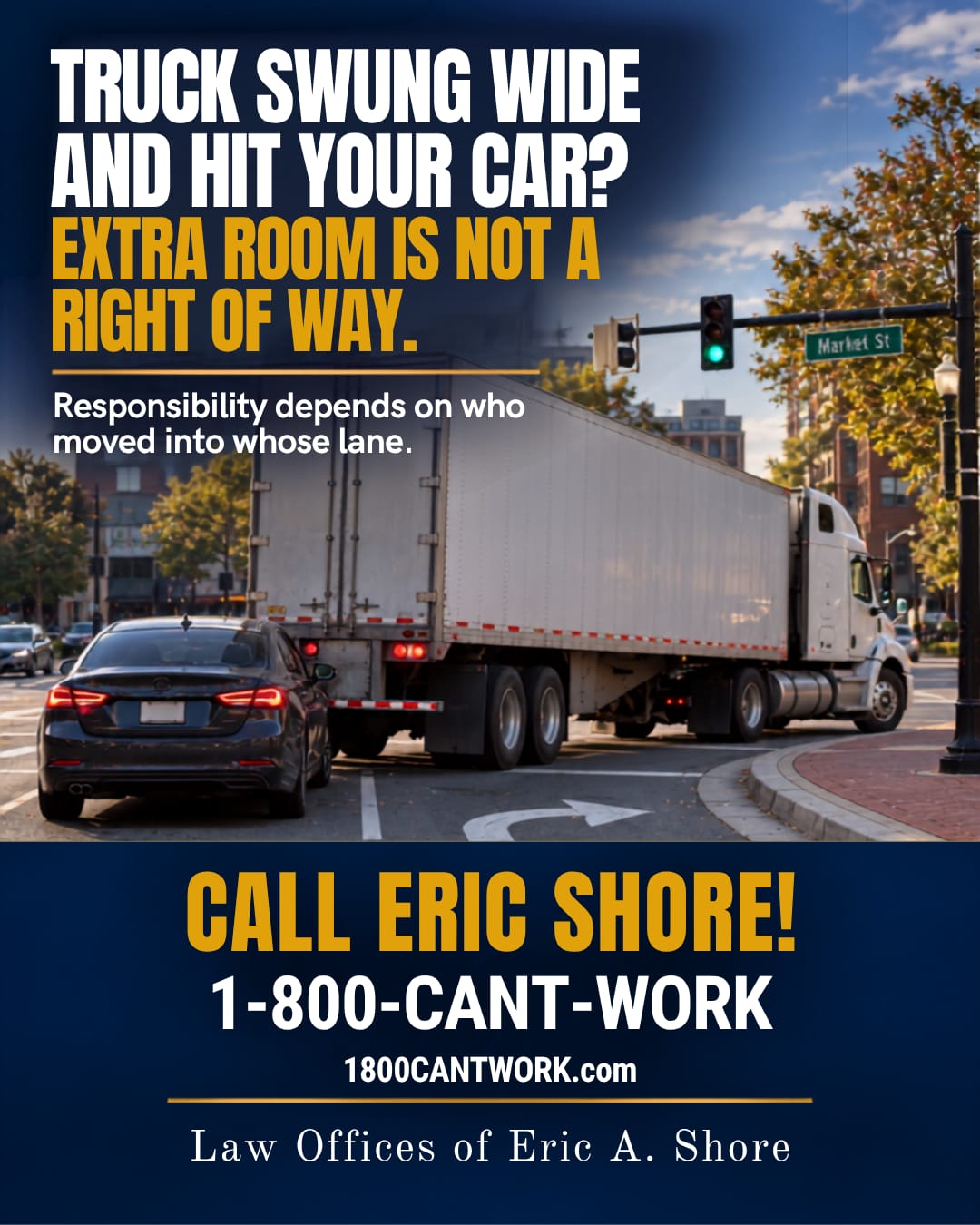
If a truck swung into your lane while making a turn and hit your car, the truck driver may be responsible. Large trucks need extra room to turn, but that does not give a driver the right to move into an occupied lane.
The first questions I would ask are where your car was before the truck started turning, when the turn signal came on, whether the driver could see you, and which vehicle moved into the other’s space. Video, damage patterns, lane markings, witnesses, and photographs can help answer those questions.
Wide-turn crashes often happen because the cab clears a car but the trailer does not. By the time the driver of the smaller vehicle realizes the trailer is coming toward them, there may be nowhere to go.
Why Do Trucks Swing Wide When They Turn?
Tractor-trailers need more room to turn than passenger cars because the trailer does not follow exactly the same path as the cab. The rear wheels of the trailer follow a tighter path through the turn. This is commonly called off-tracking.
That is why a truck may need additional roadway to complete a turn. Commercial drivers are trained to account for that movement and for the cars, bicyclists, and pedestrians around them.
The fact that a truck needed extra room does not decide who caused the crash. The real question is whether the driver made the turn safely.
Suppose you are already stopped in the right lane at a red light. A tractor-trailer pulls alongside you, begins a right turn, and its trailer comes across your lane and hits your car. That is very different from seeing a truck signaling right and trying to squeeze between the truck and the curb after the turn has already begun. Those facts can change who is responsible.
Who Is at Fault if a Truck Swings Into Your Lane?
A truck driver may be at fault if the truck or trailer enters your occupied lane because the driver failed to leave enough clearance, failed to check the mirrors, turned from an unsafe position, or misjudged the trailer’s path. I would pay particular attention to whether your car was already established in the lane before the truck began turning.
A car that had been sitting there for several seconds presents a much different case from a car that entered the space after the truck started the turn. Insurance companies sometimes focus heavily on where the vehicles ended up, but I care more about what happened immediately before impact.
Who was there first? Who changed direction? When did the truck signal? Did the trailer cross a lane line? Video showing those few seconds can answer questions that photographs of the final resting positions cannot.
Am I at Fault if I Was Beside the Truck When It Turned?
Being beside a truck does not automatically make you responsible for the accident. Trucks have large blind spots, but commercial drivers know those blind spots exist and are expected to monitor the traffic around them.
How your car got there matters. If you had been beside the truck for some time, the driver may have seen you before beginning the turn. If the truck passed your car and then brought the trailer across your lane, that matters too. If you were stopped in traffic, you may not have had anywhere to go.
Trying to pass a truck on the right after it has clearly begun a right turn creates a different situation. Calling something a “blind-spot accident” does not answer who caused it. You still have to determine what both drivers were doing before the collision.
What if the Trailer Hit My Car After the Front of the Truck Passed Me?
The truck may still be responsible. This is one of the ways wide-turn crashes happen.
The cab can pass your vehicle safely while the trailer follows a tighter path and comes across your lane. A truck driver has to keep track of the trailer throughout the turn, not just whether the front of the tractor clears another vehicle.
The damage can help reconstruct what happened. So can scrape marks, lane markings, tire marks, photographs, and video. Damage near the middle or rear of the trailer does not automatically mean you drove into the truck. The trailer itself may have been moving across your path.
What if the Truck Driver Says I Tried to Pass on the Right?
That is a common defense, and sometimes the evidence supports it. Other times it does not.
A camera may show that your car was already stopped beside the truck before the turn began. It may show the truck passing you and then cutting across your lane. Or it may show that you entered the space after the truck had already begun turning.
This is also why I would be careful about saying things to an insurance adjuster such as, “Maybe I was in his blind spot,” or, “I guess he didn’t see me.” You may simply be trying to make sense of the accident. The insurer may later characterize that guess as an admission.
Does a Truck’s Turn Signal Give It the Right of Way?
No. A turn signal tells other motorists what the driver intends to do, but it does not automatically give a truck the right to enter a lane that is already occupied.
The timing matters too. A signal that has been flashing well before the truck reaches the intersection is different from one that comes on as the truck is already moving across another vehicle’s path.
Drivers of smaller vehicles still have to use reasonable care around turning trucks. But a turn signal is evidence. It is not automatic permission to hit a vehicle already beside the truck.
Can I Still Recover if I Was Partly at Fault?
Possibly. Pennsylvania and New Jersey both use comparative negligence rules.
In general, your compensation can be reduced by your percentage of fault. If you are found 51 percent or more responsible, you generally cannot recover from the other side under the comparative negligence rules that apply in those states.
For example, the trucking company’s insurer may argue that you should have realized the truck was turning and stayed farther away. You may respond that the truck crossed into a lane you were already occupying. A jury can assign percentages of responsibility based on what each driver did.
That is why physical evidence matters so much in these cases. A short video of the turn can be more valuable than pages of arguments about who should have seen whom.
Can the Trucking Company Be Responsible Too?
Yes. The investigation often should not stop with the driver.
The trucking company may be responsible for the driver’s conduct while the driver was doing company work. There can also be questions about training, supervision, prior safety problems, driver qualifications, vehicle maintenance, and whether the company pressured drivers to meet unrealistic schedules.
The route may matter too. This can be particularly important in Philadelphia and South Jersey, where trucks sometimes have to maneuver through narrow streets, tight intersections, parked cars, loading areas, and older road layouts. GPS information, dispatch
messages, delivery records, training records, and driver files may explain far more than the driver’s account alone.
Who Else Could Be Responsible for a Wide-Turn Truck Crash?
Do not assume the company name painted on the truck is the only company involved. One company may employ the driver, another may own the tractor, someone else may own the trailer, and a delivery or logistics company may control where the truck is going and when it has to arrive.
In a serious injury case, those relationships should be understood before deciding who may be responsible. There are also less common cases involving defective mirrors, cameras, steering components, or other truck equipment.
What Evidence Is Most Important After a Wide-Turn Truck Accident?
Video is often one of the first things I would look for because it can show the entire turn rather than just the aftermath. Possible sources include traffic cameras, nearby businesses, houses, buses, dash cameras, and other vehicles.
Some systems overwrite recordings quickly, so delay can matter. Trucking companies often send their own investigators within hours, which is why early preservation matters. Link that sentence to:
Photographs taken at the scene are also important. Do not photograph only the damage. Pictures of the lanes, intersection, curb, signs, truck, trailer, company markings, identifying numbers, and available turning space may help reconstruct the collision.
The truck and trucking company may have additional information, including GPS records, electronic logging information, dispatch communications, inspection records, and other data.
What Should I Do After a Truck Swings Into My Car?
After a serious wide-turn crash, focus first on your safety and medical needs. Then preserve what you reasonably can before it disappears.
- Call the police, request medical help if needed, and get medical care for any injuries.
- Tell the officer what you actually saw, including whether the truck or trailer entered your lane.
- Photograph both vehicles, the entire intersection, lane markings, signs, truck numbers, company names, and damage.
- Get names and contact information for witnesses.
- Look for nearby businesses, houses, buses, or vehicles with cameras.
- Save your photographs, videos, repair information, and other records.
- Avoid guessing about speed, distance, timing, or fault when talking with an insurance adjuster.
- In a serious case, take steps quickly to preserve video, trucking records, and electronic data.
Do not enter moving traffic or put yourself near an unstable truck to take photographs. Get what you safely can.
How Long Do I Have to File a Truck Accident Claim in Pennsylvania or New Jersey?
Pennsylvania and New Jersey generally have a two-year statute of limitations for many personal injury lawsuits. Pennsylvania’s general personal injury deadline appears in 42 Pa.
C.S. § 5524. New Jersey’s appears in N.J.S.A. 2A:14-2.
There are important exceptions. If a Pennsylvania government unit may be responsible, written notice is generally required within six months under 42 Pa. C.S. § 5522. New Jersey’s Tort Claims Act generally requires notice of a claim against a public entity or public employee within 90 days under N.J.S.A. 59:8-8.
The lawsuit deadline also does not preserve evidence. Video can be overwritten. Trucks can be repaired. Electronic information can disappear. Witnesses become harder to find and drivers leave companies.
You may have two years to file a lawsuit. You may have only days or weeks to save some of the best evidence.
What Matters Most in a Wide-Turn Truck Accident?
The most important question is usually who moved into whose space. A trucking company may say you were in the driver’s blind spot or tried to pass on the right. You may say you were already occupying your lane when the trailer came across it.
Neither version should automatically be accepted without looking at what actually happened. The strongest evidence often shows where both vehicles were before the turn began, when the truck signaled, what the driver could see, and how the trailer moved.
At the Law Offices of Eric A. Shore, we have helped tens of thousands of injured and disabled people. We investigate serious truck accidents to find out what happened and which companies may be responsible.
If a truck swung wide and seriously injured you in Pennsylvania or New Jersey, call 1-800-CANT-WORK or visit 1800CantWork.com.
This article provides general information and is not legal advice. Every claim depends on its facts, insurance coverage, deadlines, and the law that applies.



