By Eric A. Shore, Founding Attorney, Law Offices of Eric A. Shore
Eric has practiced injury and disability law in Pennsylvania and New Jersey since 1994. Last updated: September 2026
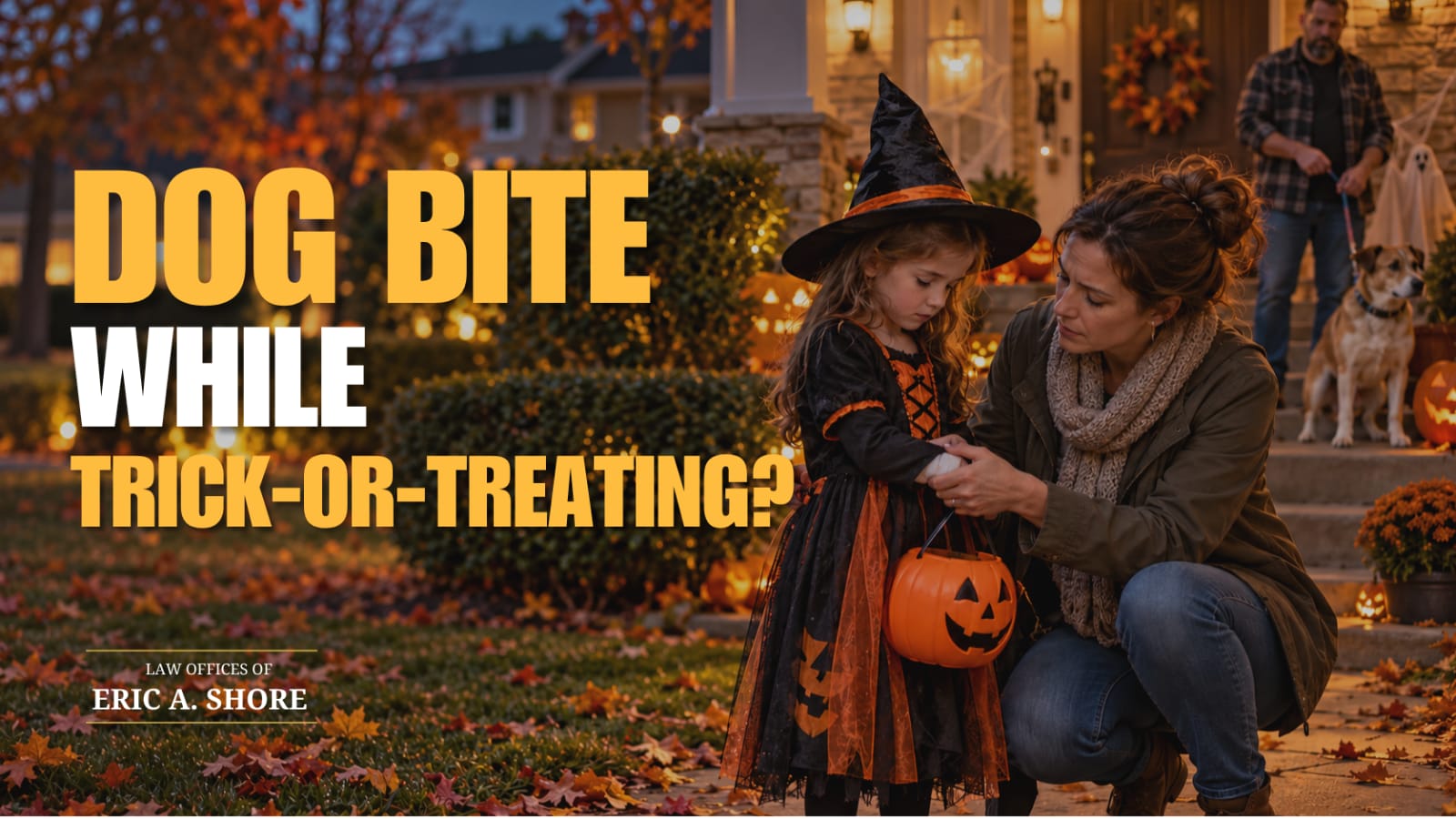
If your child was bitten by a dog while trick-or-treating, at a Halloween party, or at a trunk-or-treat in Pennsylvania or New Jersey, take care of the injury, get it checked by a medical provider, and find out who owns the dog and whether its rabies vaccination is current. Take pictures of the bite, save the costume, and write down exactly where it happened and who saw it.
Then look for cameras. A porch may have a doorbell camera, a party host may have home security cameras, and a neighbor’s camera may have caught the bite even if the house where it happened did not. Ask that the video be saved. After more than 30 years representing injured people in Pennsylvania and New Jersey, I would rather have a family preserve too much evidence than discover a few weeks later that something important is gone.
Key Takeaways
- A dog does not have to be known as dangerous for a serious Halloween bite to result in a claim.
- New Jersey generally holds a dog owner responsible when the dog bites someone in a public place or someone lawfully on private property, even if the dog never bit anyone before.
- Pennsylvania requires the dog’s owner or keeper to pay medical treatment costs resulting from a dog attack. Other compensation depends on the circumstances, including how the dog was controlled.
- Halloween can overwhelm some dogs. That may explain why a friendly dog suddenly bites, but it does not excuse the owner from controlling the dog.
- Homeowners or renters insurance may cover a dog bite. When coverage applies, the insurance company may handle and pay the claim rather than the dog’s owner paying it directly.
- Adults generally have two years to file many personal injury claims in Pennsylvania and New Jersey. For children, the deadline is generally extended until after they turn 18.
Doorbell and security video can disappear long before any legal deadline.
Why Would a Friendly Dog Suddenly Bite a Child on Halloween?
I understand why a parent would be confused. You may know the dog, and your child may have petted it before. The owner may tell you right away, “He’s friendly. He’s never bitten anyone.” That may all be true.
Think about what Halloween can look like to a dog. There are masks, costumes, and screaming kids running down the sidewalk. Decorations make noise, strangers walk toward the house all evening, the doorbell rings over and over, and the front door opens every few minutes. Some dogs could not care less. Others get scared, territorial, anxious, or overwhelmed, so I am not surprised when someone tells me a dog that had always been friendly suddenly bit a child on Halloween.
That may explain why the dog bit. It does not excuse the owner. If you know children will be coming to your door all evening, controlling your dog becomes more important, not less. Put the dog in another room, use a gate, or keep it away from the front door. A frightened dog is not the child’s responsibility, and the fact that a dog never bit anyone before does not automatically mean there is no claim.
Is a Homeowner Responsible If Their Dog Bites a Trick-or-Treater in New Jersey?
New Jersey law is favorable to many dog bite victims. Under New Jersey dog bite law, found at N.J.S.A. 4:19-16, a dog owner can be responsible when the dog bites someone in a public place or while that person is lawfully on private property, including the owner’s own property. The owner can be responsible even if the dog never bit anyone before and even if the owner did not know the dog was vicious.
Under the statute, someone may be lawfully on private property because of the owner’s express or implied invitation, and that matters on Halloween. A porch light, Halloween decorations, candy at the door, and a homeowner answering the door for trick-or-treaters can help show that children were invited to approach the house. A bite on a public sidewalk is even more straightforward, because the statute expressly covers bites in public places.
Different facts may require a closer look. For example, a child entering a fenced backyard or another area where visitors were not invited could raise different issues.
Is a Dog Owner Responsible for a Halloween Dog Bite in Pennsylvania?
Pennsylvania handles dog bite claims differently. The Pennsylvania Dog Law requires owners to keep their dogs confined on their property or under reasonable control, and it
requires an owner or keeper to pay medical treatment costs resulting from an attacking or biting dog. Other compensation, including compensation for pain, scarring, or lost income, depends on the facts surrounding the attack and the legal basis for the claim.
Halloween can make those facts especially important. If an owner knows dozens of children will be approaching the front door but leaves the dog loose near that door, what happened when the door opened matters. Did the dog bolt outside? Was anyone controlling it, or was it on a leash? Was it roaming the yard, or was a gate left open? Those are the kinds of questions I would want answered after a Halloween dog attack.
Pennsylvania is sometimes described as a “one free bite” state, but that shorthand can be misleading. How the dog was controlled and what happened during the attack can matter even if the dog had never bitten anyone before.
What If My Child’s Costume or Behavior Startled the Dog?
The dog owner or insurance company may argue that a child provoked the dog by reaching toward it, shouting, running, or doing something else right before the attack. That does not automatically defeat a claim. A child walking up to a house in costume on Halloween is doing something a homeowner handing out candy should expect.
There is also an obvious difference between a child simply reaching toward a dog and someone deliberately teasing, hitting, or tormenting an animal. The child’s age and the exact circumstances can matter. This is another reason video can be so useful, because it may show what happened during the few seconds before the dog bit.
What Should You Do Right After a Dog Bite While Trick-or-Treating?
- Take care of the injury. Wash the wound with soap and water. Seek prompt medical attention for a deep or serious wound, a bite to the face or hand, uncontrolled bleeding, signs of infection, or when you do not know whether the dog is vaccinated against rabies. With a child, I would rather have a parent call the pediatrician or another medical provider and find out whether the bite should be examined than guess.
- Ask about the dog’s rabies vaccination. Tell the medical provider what you learn. A healthy dog that bites someone may be confined and observed for 10 days in coordination with public health authorities. Do not try to decide for yourself whether rabies treatment is necessary.
- Write down the address. On a dark street full of trick-or-treaters, it is surprisingly easy to lose track of which house it was. Note the house number or save the location on your phone.
- Identify the owner. Get the owner’s name, address, and phone number.
- Photograph the bite. Take pictures as soon as possible and continue taking them as the wound heals.
- Photograph the scene. Capture the porch, doorway, gate, fence, yard, lighting, and anything else that may show where the dog came from.
- Look for cameras. Ask the homeowner and nearby neighbors to preserve doorbell or security footage that may show what happened. Halloween is a night when many cameras capture repeated activity around the front of a home.
- Get witness information. Other parents, neighbors, and people in your trick-or-treating group may have seen exactly what happened.
- Keep the costume. Save torn or bloodied clothing or costume pieces, and do not throw them away.
- Report the bite. Depending on where it happened, that may mean contacting animal control, police, or the appropriate local health authority.
Doorbell or security video can become some of the best evidence in a Halloween dog bite case. It may show exactly where the child was standing, whether the dog was loose, how the dog reached the child, and what happened right before the bite. It can also disappear quickly if the recording is deleted or overwritten.
What If You Don’t Know Whose Dog Bit Your Child?
Sometimes a loose dog runs toward a group of children and disappears before anyone identifies the owner. Report the bite promptly and give animal control or police as detailed a description as possible, including the street, the approximate location, what the dog looked like, and the direction it went. Ask nearby residents whether they recognize the dog and whether their cameras recorded it.
Identifying the dog matters medically, because doctors and public health authorities may need information about rabies risk. It also matters legally, because identifying the owner may lead to the insurance coverage available for the injury.
What If a Dog Bites Your Child at a Halloween Party or Trunk-or-Treat?
The important questions do not disappear because the bite happened somewhere other than a front porch. A child bitten at a friend’s Halloween party may have been invited onto the property, which can be important under New Jersey’s dog bite statute. In Pennsylvania, the circumstances of the attack and how the dog was controlled may be important.
A trunk-or-treat at a school, church, business, or community parking lot may involve additional facts, because the dog’s owner and the property owner may be different people. Get the dog owner’s information, photograph the injury, identify witnesses, and find out whether the event or nearby property had cameras.
Who Pays When a Neighbor’s Dog Bites a Trick-or-Treater?
Homeowners insurance or renters insurance may cover injuries caused by a dog. That matters because many parents hesitate to pursue a claim when the dog belongs to someone on their street, a friend, or a relative. They do not want to create a financial problem for someone they know. When insurance coverage applies, however, the claim may be handled and paid by the insurance company rather than directly by the dog’s owner.
Coverage is not automatic. Policies can contain exclusions, restrictions, limits, or other provisions affecting dog-related claims. Finding out what insurance exists is one of the first things we investigate after a serious dog bite.
Should You Talk to the Homeowner’s Insurance Company After a Halloween Dog Bite?
Do not assume you have to give the other side’s insurance company a recorded statement simply because an adjuster asks for one. The adjuster may ask what the dog was doing, whether your child touched it, exactly where everyone was standing, and how serious the injury is.
The problem is that some injuries develop over time. Nobody knows a few days after Halloween exactly what a facial scar will look like by spring, and the same can be true of nerve injuries, numbness, restricted movement, or complications from an infection. If the injury is significant, understand your rights before giving a recorded statement or signing documents for the other side’s insurance company.
When Is a Halloween Dog Bite Serious Enough to Call a Lawyer?
A minor scratch usually does not need a personal injury lawyer. A dog bite deserves a closer look when it involves:
- A child
- The face, neck, or scalp
- The hand, wrist, or fingers
- Deep puncture wounds
- Stitches or surgery
- Nerve or tendon damage
- Numbness or weakness
- Infection
- Significant scarring
- A recommendation to see a plastic surgeon
- Missed work
- Lasting pain or restricted movement
Hand injuries deserve particular attention, because even a relatively small wound can interfere with grip, sensation, strength, and movement. Adults bitten while walking with their children may miss work because of their own injuries, and parents may lose work taking an injured child to emergency treatment, follow-up visits, surgery, or other appointments. Keep pay records and documentation showing the time missed.
What If a Halloween Dog Bite Leaves a Scar on My Child’s Face?
Start taking photographs immediately and continue taking them during the healing process. A scar can look dramatically different on Halloween night, after stitches are removed, several months later, and a year after the injury. Those photographs create a record that cannot be recreated later.
Facial injuries can also require treatment from plastic surgeons, dermatologists, or other specialists. If future scar treatment or surgery is recommended, keep those records and recommendations. The fact that a child may not have a procedure until later does not mean that future treatment should be ignored when the claim is evaluated.
How Long Do You Have to File a Halloween Dog Bite Claim in Pennsylvania or New Jersey?
Adults generally have two years from the date of the injury to file many personal injury lawsuits in Pennsylvania and New Jersey. That means an adult bitten on October 31, 2026 generally faces an October 31, 2028 deadline, although exceptions can change the calculation.
Different rules apply to children. In Pennsylvania, the years before a child turns 18 generally do not count toward the deadline. New Jersey also has rules that can pause the deadline for qualifying personal injury claims while the injured person is a minor.
Parents should not treat that extra time as a reason to wait, because the evidence is much less patient. Doorbell video gets overwritten, witnesses forget exactly what happened, dogs and owners move, fences get repaired, and Halloween decorations disappear the next morning. The evidence that helps prove a Halloween dog bite case can be gone long before the legal deadline.
Talk to a Dog Bite Lawyer in Pennsylvania or New Jersey
Most Halloween nights end with too much candy and tired kids. A serious dog bite is different. A child may need stitches, scar treatment, or surgery, and an adult may miss work. A family may suddenly be dealing with an infection, nerve damage, medical bills, and an insurance company asking questions before anyone knows how serious the injury will become.
The Law Offices of Eric A. Shore has helped tens of thousands of injured and disabled people over more than 30 years, with offices in Philadelphia and Cherry Hill serving families throughout Pennsylvania and New Jersey. If you or your child was bitten by a dog while trick-or-treating, at a Halloween party, or at a trunk-or-treat, we can investigate what happened, identify the insurance that may apply, preserve important evidence, and explain your options. Call 1-800-CANT-WORK or visit 1800CantWork.com.
This article provides general information and is not legal advice. Rights, insurance coverage, and deadlines depend on the facts of each case and applicable law.