By Eric A. Shore, Founding Attorney, Law Offices of Eric A. Shore
Eric has been an injury and disability lawyer since 1994, more than 30 years. Last updated: October 2026
Reading time: About 5 minutes
Ǫuick Answer
If you slip on a wet floor in a Florida store, the store is not automatically responsible for your injuries. You generally must prove the store knew or should have known about the dangerous condition and failed to take appropriate action.
The good news is that you do not need an employee to admit seeing the spill. Photos, video, employee statements, maintenance records, and even how the spill looked can help prove your case.
And just because nobody witnessed your accident does not mean you have no case.
Why Is a Store Slip and Fall Case Harder in Florida?
Florida has a special law for falls caused by spills in businesses. Under Florida Statutes § 768.0755, you must prove the business had actual or constructive knowledge of the dangerous condition.
There are two kinds of knowledge.
Actual knowledge means the store knew about the spill. Perhaps a worker saw it, or a customer reported it.
Constructive knowledge means the store should have known about it, even if nobody admits seeing it.
You can establish constructive knowledge by showing that the spill was there long enough that the store should have discovered it, or that the dangerous condition occurred so regularly that the store should have expected it.
You only need to establish one of those two grounds for constructive knowledge, not both.
What If Nobody Knows How Long the Spill Was There?
Suppose you slip on water in a grocery aisle. The manager says nobody reported a spill, and the store has no record of when it started.
That does not automatically mean you have no case. The evidence may tell the story, including:
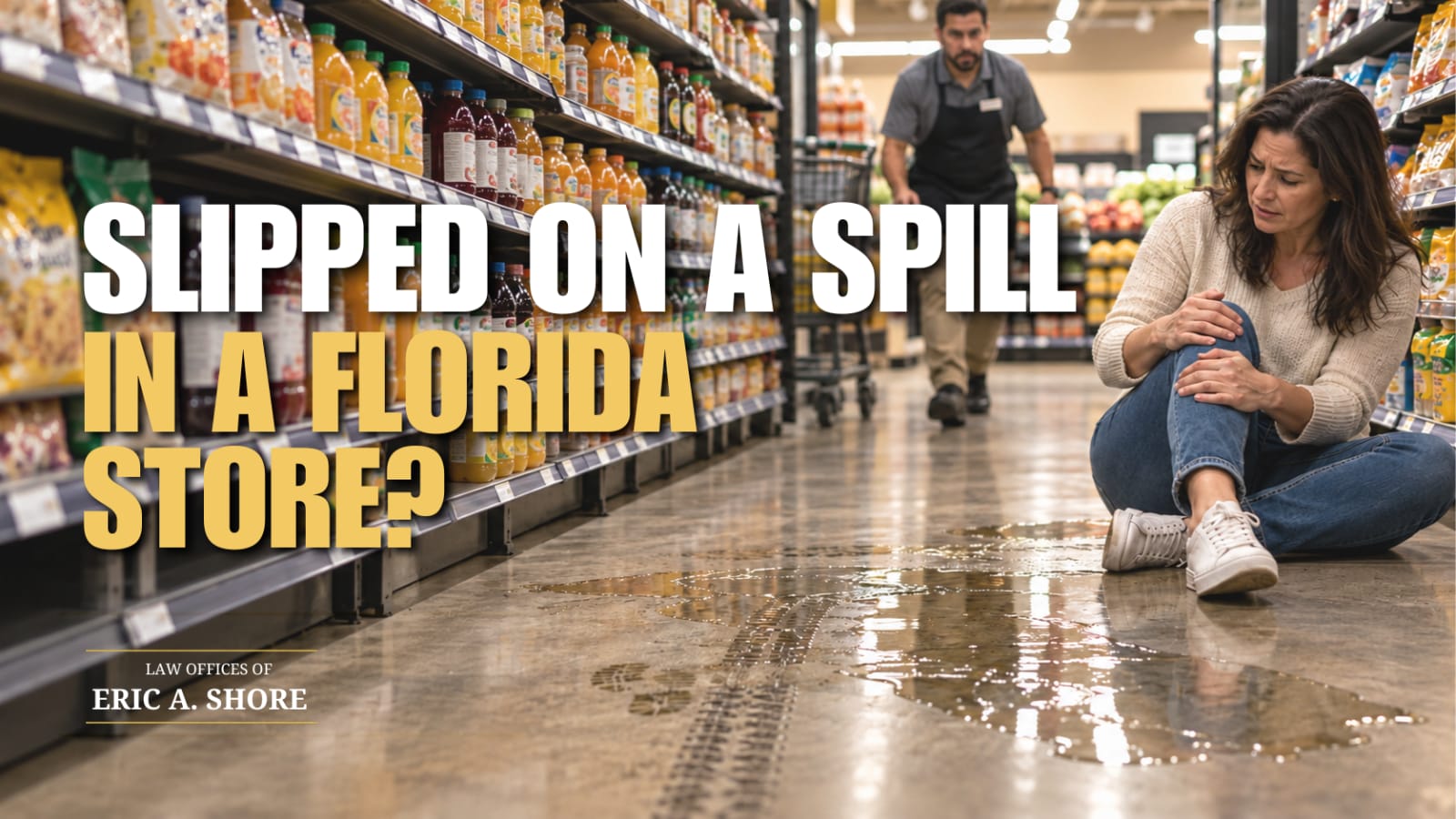
- Footprints or shopping cart tracks through the liquid
- Dirt or debris mixed into the spill
- Liquid that has partially dried
- Video showing when the spill appeared
- Employees walking past the area before your fall
- Earlier complaints about the same dangerous condition
These details may help establish how long the spill was there. But a spill alone, or an employee standing nearby, does not necessarily prove negligence.
The question is whether the evidence shows that the store knew or reasonably should have known about the danger.
A Real Example: A Fall in a South Florida Store Bathroom
We recently had a client who slipped and fell in the bathroom of a big box store in South Florida. There were no witnesses to the accident.
Does that mean we cannot prove the case? Not necessarily.
One of the first things I would want to do is speak with the store employees who were working around the time of the fall.
Had anyone recently cleaned or mopped the bathroom? Did an employee know the floor was slippery? Was a sink or toilet leaking? Had customers complained about water on the floor before?
These are the kinds of questions that can change a case.
For example, if an employee had just mopped the bathroom and left the floor dangerously wet without a warning sign, that could be important evidence. If a toilet had been leaking for days, maintenance records or employee statements might establish that the store knew about the problem.
Even if nobody saw the actual fall, there may be plenty of evidence about what happened before it.
That is why I believe it is important to investigate these cases rather than immediately assuming there is no claim simply because nobody witnessed the accident.
What If the Store Has the Same Problem Over and Over?
Sometimes you can establish that a store should have known about a dangerous condition without proving exactly how long that particular spill was there.
Picture a supermarket refrigerator that repeatedly leaks water into the same aisle. Employees have cleaned up the water several times, but the leak keeps returning.
Florida law recognizes that a dangerous condition occurring regularly may be foreseeable.
A recurring leak, repeated complaints, or prior maintenance problems may help show that the business should have anticipated the danger.
Why the Seriousness of Your Injury Matters to Us
When we decide whether to accept a personal injury case, we do not look only at whether the store was negligent. We also consider the seriousness of the injury.
I think it is important for people to understand how lawyers evaluate these cases.
If someone suffers a relatively minor injury, we generally want the evidence of liability to be fairly clear. Otherwise, the time and expense required to prove negligence may outweigh the potential recovery.
But what if the person broke a hip, needed surgery, or suffered a permanent injury? That is a different situation.
Here in South Florida, we have many older residents. A fall that might cause a younger person a bruise can cause an older adult a fractured hip, a lengthy hospitalization, or a permanent loss of independence.
When the injuries are serious, we may be willing to invest substantially more time and resources investigating a case where liability is not immediately clear.
That could mean interviewing employees, reviewing maintenance records, investigating prior complaints, obtaining surveillance footage, or hiring experts.
A serious injury does not automatically make the store responsible. But it can make a more extensive investigation worthwhile, even when proving negligence will be difficult.
Why You Should Ask the Store to Save the Video
Store surveillance footage can be some of the best evidence in a slip and fall case.
It may show when a spill appeared, whether employees walked past it, and what happened immediately before the accident.
Unfortunately, some stores routinely record over old footage. That is why it is important to identify relevant cameras and request preservation of the recordings promptly.
An attorney can help identify and seek preservation of evidence before it disappears.
What If the Store Blames You?
Stores and insurance companies sometimes argue that customers were distracted, looking at their phones, or should have noticed the dangerous condition.
Florida follows a modified comparative fault rule in applicable negligence cases.
Under Florida Statutes § 768.81, your compensation may be reduced by your percentage of fault. If you are found more than 50% responsible for your injuries, you generally cannot recover damages under that rule.
But just because a store says you should have seen the spill does not mean you were negligent.
The lighting, visibility of the liquid, location of the spill, and presence or absence of warning signs can all matter.
What Should You Do After Slipping in a Florida Store?
If you can do so safely, take these steps:
- Report the accident. Tell a manager and ask for an incident report.
- Take pictures. Photograph the spill, surrounding floor, and any warning signs before anything is cleaned.
- Identify witnesses. Get names and contact information from anyone who saw the fall or the dangerous condition.
- Ask about cleaning. Find out whether employees recently mopped the area or knew about the problem.
- Look for cameras. Note which cameras may have recorded the area.
- Get medical attention. Explain how you fell and describe your injuries.
- Save everything. Keep your shoes, clothing, photographs, medical records, and communications with the store.
Do not guess about how long the spill was there. If you do not know, say so. Other evidence may help establish what happened.
The Bottom Line
After more than 30 years representing injured people, I have learned that some cases that initially appear difficult become much stronger after a thorough investigation.
A store may deny responsibility, and there may be no witnesses. But employees, maintenance records, recurring problems, and surveillance footage may tell a different story.
If you suffered a serious injury in a Florida store, do not assume you have no case simply because nobody saw you fall.
Injured in South Florida? Let’s Talk.
Our law firm now has an office in downtown Fort Lauderdale, and I would be glad to meet with you personally by appointment to discuss your situation.
Law Offices of Eric A. Shore
200 South Andrews Avenue, Suite 900 Fort Lauderdale, FL 33301
Call 1-800-CANT-WORK or visit our Fort Lauderdale office and contact page to arrange a consultation.
Get More with Shore!
This article provides general information and is not legal advice. Every slip and fall case depends on its particular facts, available evidence, applicable defenses, and current Florida law.