By Eric A. Shore, Founding Attorney Last updated: September 2026
ǪUICK ANSWER
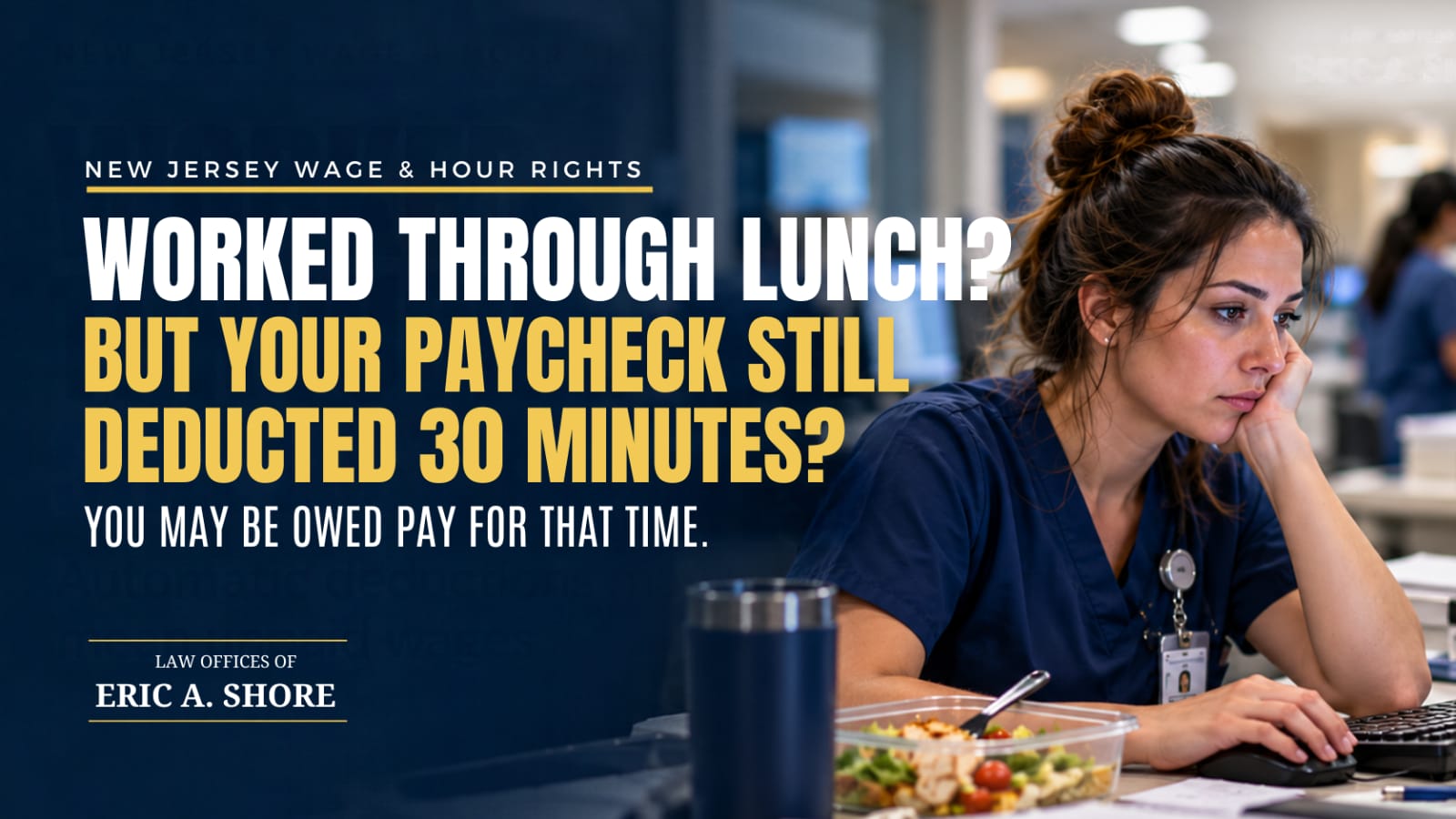
If your hospital takes 30 minutes out of your time for lunch even when you never really got a lunch break, you may be entitled to be paid for that time.
Maybe you finally sit down to eat and a call light goes off. Someone needs help with a patient. Your phone or pager goes off. You spend part of lunch charting. There is nobody available to cover you. Or the shift is simply too busy to take 30 uninterrupted minutes.
Then you look at your timecard and the 30 minutes were deducted anyway.
That is the problem this article is about.
Federal law generally allows a bona fide meal period to be unpaid when an employee is relieved from work duties. An automatic deduction does not change the rules about paying employees for time that legally counts as work.
Our offices in Philadelphia, Drexel Hill, Cherry Hill and Atlantic City are surrounded by hospitals and major healthcare systems. After representing employees for more than 30 years, I have seen how something that looks like a small payroll issue can become much bigger when the same thing is happening to employees throughout a workplace.
Can My Hospital Deduct 30 Minutes If I Did Not Really Get Lunch?
An automatic lunch deduction is not illegal by itself.
Many hospitals, nursing homes and health systems use timekeeping software that automatically subtracts 30 minutes from a shift. Employees do not have to clock out for lunch because the computer assumes they took it.
But what if the computer is wrong?
The U.S. Department of Labor has specifically addressed automatic meal deductions in healthcare. Employers using these systems are still responsible for
making sure employees receive the meal period or are properly paid when the time counts as work.
In other words, what matters is not simply what the timekeeping system says happened.
What matters is what actually happened during your shift. What If I Never Actually Get My 30 Minute Lunch?
Healthcare workers know what a scheduled lunch and an actual lunch can look like. You may technically have a 30 minute meal period, but:
- There is nobody available to cover your patients
- You eat at the nurses’ station while remaining responsible for patients
- You answer call lights while eating
- A physician or supervisor needs you
- You answer your work phone, pager or radio
- You chart or finish documentation
- You get called back after 10 or 15 minutes
- You are so busy that you never sit down at all Those facts can matter.
The Department of Labor even uses an example involving an hourly registered
nurse whose meal periods are frequently interrupted by residents asking for assistance. The DOL explains that when the interruptions make the meal period predominantly for the employer’s benefit, the time must be paid.
What If I Ate Lunch but Kept Working?
Eating does not automatically make the time an unpaid meal period.
You might eat a sandwich while charting. You might eat at a desk while answering calls. You might remain responsible for patients because nobody else can cover them.
The question is not simply whether you ate.
The question is whether the time qualified as an unpaid meal period under the law.
What If My Hospital Has a “No Lunch” Button?
Some hospitals have a button, form or other procedure employees can use when they miss lunch.
That can be an important fact, but it does not necessarily end the question.
Suppose employees regularly work through lunch, managers know it is happening, and employees do not report every missed meal. Or suppose employees are discouraged from using the no lunch procedure.
Federal wage law generally requires an employer to pay for work it knows or has reason to believe is being performed. Whether the employer knew about the unpaid work and whether employees had a reasonable way to report it can be important.
What If My Manager Knows We Work Through Lunch?
That can matter too.
Maybe the unit is routinely understaffed. Maybe supervisors see employees eating while working. Maybe everyone knows there is rarely enough coverage for an uninterrupted lunch.
An employer generally cannot avoid paying for compensable work merely because the work was not entered correctly on a timecard.
The specific facts matter, including what the employer knew, what employees were instructed to do and what actually happened when someone reported a missed meal.
Is This Happening to Your Coworkers Too?
This is one of the first questions I would ask.
If one nurse occasionally misses lunch and forgets to correct a timecard, that is one situation.
But what if nurses throughout a unit regularly work through lunch? What if the same thing happens on multiple floors or shifts?
What if aides, technicians and other hourly employees have the same problem?
What if everyone uses the same timekeeping system and the same 30 minutes disappear automatically?
That can be a very different situation.
“When someone tells me they are losing 30 minutes of pay for a lunch they worked through, one of my first questions is whether it is happening to their coworkers too. At a large hospital, the same 30 minutes repeated across hundreds of employees can add up quickly.”
Eric A. Shore, Founding Attorney
If this sounds like your workplace, look at your own time records and think about whether the same thing is happening to the people working beside you.
Which Healthcare Workers Can Be Affected?
This issue is not limited to nurses.
Automatic meal deductions can affect hourly:
- Registered nurses
- LPNs
- CNAs
- Patient care technicians
- Nursing home aides
- Respiratory therapists
- Radiology technicians
- Lab technicians
- Unit clerks
- Other hospital and healthcare employees
Hourly registered nurses may be entitled to overtime even though nursing is a professional occupation.
Different rules can apply to employees who are properly classified as exempt. Your job title alone does not necessarily decide whether you are entitled to overtime.
How Much Can 30 Minutes a Shift Really Be Worth?
More than most people realize.
Five unpaid 30 minute meal periods equal 2.5 hours a week. Over 50 working weeks, that is fi25 hours.
At $40 an hour, that represents 35,000 of working time in one year.
The amount potentially owed can be greater when unpaid time causes a nonexempt employee to work more than 40 hours during a workweek because federal overtime requirements may apply.
Now think beyond one employee.
What if the same automatic deduction affects 50 employees? Or 500?
What if it has been happening for years?
That is why 30 missing minutes can deserve a much closer look.
How Far Back Can You Claim Unpaid Wages?
Under the federal Fair Labor Standards Act, employees can generally seek unpaid wages going back two years. The period can extend to three years for a willful violation.
The FLSA may also allow liquidated damages in addition to unpaid wages in appropriate cases.
State wage laws can provide additional rights, longer time periods or additional damages. Those laws depend on where you work.
Because these deadlines continue running, waiting can potentially mean losing the ability to recover older unpaid time.
Can I Get in Trouble for Asking About My Missing Lunch Pay?
Federal law prohibits certain retaliation against employees for asserting rights protected by the Fair Labor Standards Act. State laws may provide additional protections.
Fear of causing problems at work is real, particularly when you depend on the job.
You can speak privately with an employment lawyer about what has been happening before deciding whether you want to do anything about it.
What Should I Look At Before Calling a Lawyer?
Start with your own records.
Look at your recent timecards and pay stubs. See whether 30 minutes is automatically deducted.
Think about what actually happened during those meal periods.
Keep a private record of days when you worked through lunch or your meal was interrupted and what work you performed. Do not record patient names or protected health information.
Find out how employees are supposed to report a missed lunch. Is there a no lunch button, exception form or timecard correction?
Think about what happens when employees use it.
And ask yourself the question that can change the significance of the entire situation:
Is this happening to my coworkers too?
Do not take patient records, protected health information or documents you are not entitled to possess.
Frequently Asked Ǫuestions
Does federal law require my employer to give me a lunch break?
Federal law generally does not require employers to provide adult employees with meal periods.
The pay issue is different. If time legally counts as work, it generally must be counted and paid even if it happened during what was supposed to be an unpaid meal period.
What if I never pressed the no lunch button?
That does not necessarily determine whether you are owed money.
Federal law generally requires employers to compensate employees for work the employer knows or has reason to believe is being performed. What the employer knew and what procedures employees had for reporting missed meals can matter.
What if I chose to work through lunch?
That does not necessarily make the time unpaid.
Federal wage law generally requires employers to pay for work they suffer or permit employees to perform. Whether your employer knew or should have known you were working can be important.
What if I got five or five minutes to eat but not the full 30 minutes?
The circumstances matter. An interrupted meal period does not automatically qualify as an unpaid 30 minute meal period simply because you had enough time to eat something.
What if my supervisor tells us not to report missed lunches?
That is an important fact to discuss with an employment lawyer. Keep your own lawful records of what happened, but do not take patient information or confidential documents you are not entitled to have.
I am salaried. Does this apply to me?
Possibly, but different rules apply.
Employees who properly satisfy an FLSA exemption generally are not entitled to overtime. Being paid a salary or being called exempt does not by itself determine whether an employee is legally exempt.
What if this is happening to hundreds of employees?
That can matter considerably.
When employees working under the same policies or practices have similar unpaid wage claims, federal law may permit employees to pursue claims together through an FLSA collective action. Depending on the circumstances and applicable state law, claims may also potentially proceed on a class basis.
Is Your Hospital Taking 30 Minutes for a Lunch You Never Really Got?
Look at your timecard.
If 30 minutes disappears automatically even though you regularly work through lunch, write down what is actually happening during those 30 minutes.
Then ask whether the people working beside you are experiencing the same thing.
Eric A. Shore has represented employees for more than 30 years. The Law Offices of Eric A. Shore represents employees in Pennsylvania and New Jersey and can help
healthcare workers in other states connect with experienced wage and hour counsel.
Call 1-800-CANT-WORK or contact us through 1800CantWork.com to discuss your situation.