By Eric A. Shore, Founder, Law Offices of Eric A. Shore
Eric A. Shore has represented injured and disabled people for more than 30 years.
Ǫuick Answer
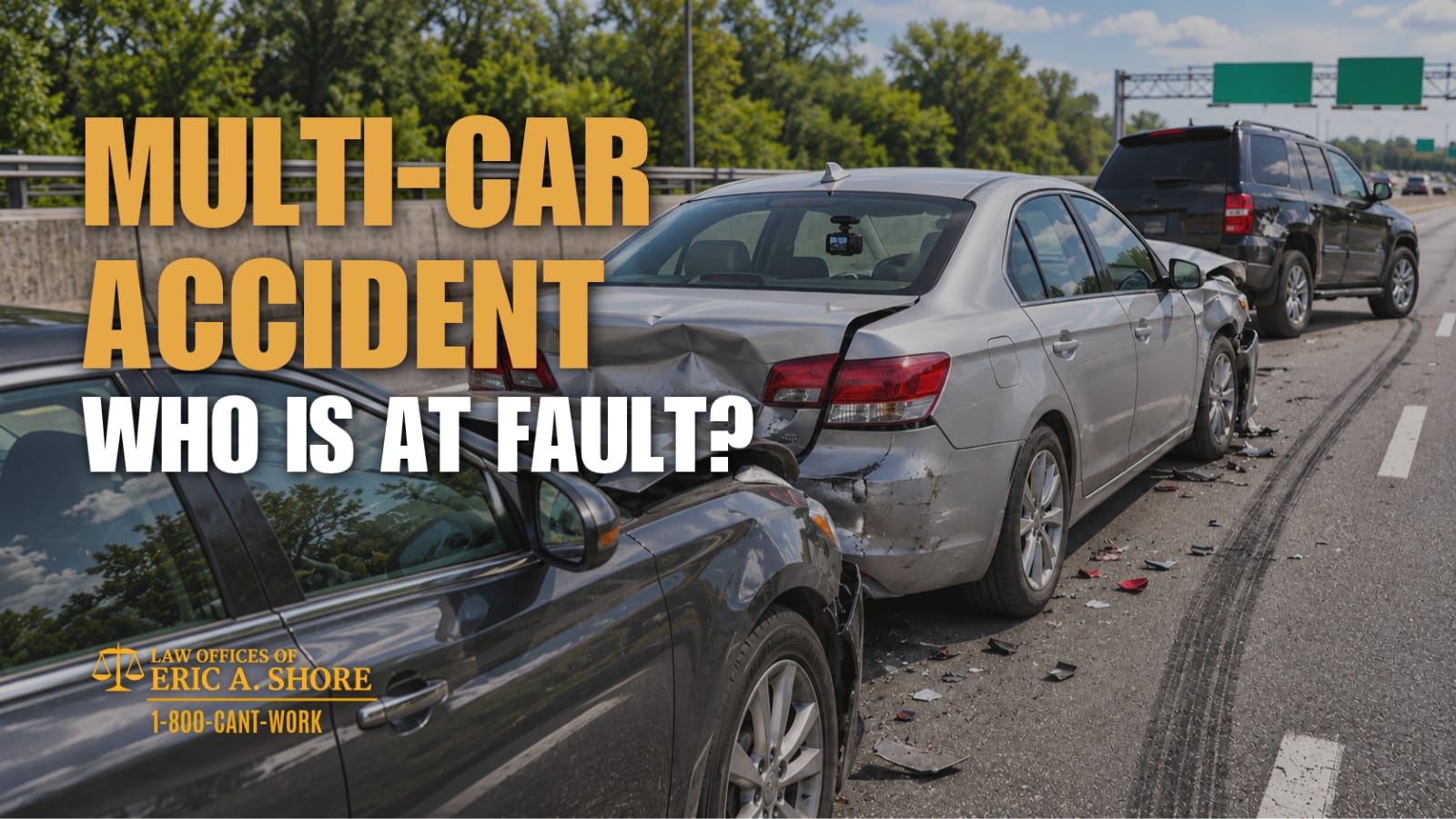
In a New Jersey multi-car accident, more than one driver can be at fault. One driver may have caused the first crash, while another was speeding, following too closely, or changing lanes without looking.
New Jersey law allows responsibility to be divided among multiple drivers. A driver found 60% or more responsible may be required to pay the full amount of your recoverable damages.
The challenge is figuring out who caused each collision, which impacts caused your injuries, and who is legally responsible for paying.
Why Is It So Hard to Determine Fault in a Multi-Car Accident?
Multi-car accidents are some of the most interesting cases I handle. They are interesting for the same reason they are challenging. It is often difficult to determine who actually caused the crash.
Did someone slam on the brakes? Was another driver speeding? Did someone change lanes without looking? Sometimes all three things happen within seconds of each other.
Imagine you’re driving on the New Jersey Turnpike. A car ahead suddenly brakes. You stop in time, but the driver behind you doesn’t. That driver hits your car and pushes it into another lane, where a truck strikes you.
Who caused your injuries?
Was it the driver who slammed on the brakes? The driver who hit you from behind? The truck driver? Or some combination of them?
Braking suddenly is not automatically negligent. Neither is being involved in a collision. The question is whether each driver acted carelessly and whether that carelessness contributed to your injuries.
That is why you cannot always determine fault simply by looking at which car hit another.
Who Is at Fault When Three Cars Rear-End Each Other?
This is a common question after a chain reaction accident.
Imagine three cars traveling in the same lane. The first car stops. The second car stops behind it. The third car fails to stop and crashes into the second car, pushing it into the first.
In that situation, the third driver may be responsible for both collisions.
But what if the second car hit the first car before the third car hit it? Now there may have been two separate collisions, with different drivers responsible for each.
And what if the third driver was speeding, making the second impact much worse?
These details matter because the injuries from one collision may be different from those caused by another.
Being the middle car does not automatically make you responsible. The evidence must establish what happened and whether you did anything wrong.
Can More Than One Driver Be Responsible for the Same Accident?
Yes. New Jersey uses a system called comparative negligence. This means a judge or jury can assign percentages of fault to the parties whose negligence contributed to your injuries.
For example, one driver might be found 70% responsible and another 30% responsible. Your own driving can count too.
Under N.J.S.A. 2A:15-5.1, you can generally recover compensation if your negligence was not greater than the combined negligence of the defendants. Your damages are reduced by your percentage of fault.
If you were 20% responsible for a crash, for example, your damages would generally be reduced by 20%.
That makes it important to determine what each driver actually did.
What Is New Jersey’s 60% Rule, and Why Does It Matter?
New Jersey has an important law that can affect how much money you can collect when several drivers are responsible for the same injuries.
Under N.J.S.A. 2A:15-5.3, a driver found 60% or more responsible for the total damages may be required to pay the full amount of your recoverable damages. A driver found less than 60% responsible generally pays only their percentage.
Here is an example.
You were injured in a three-car accident and did nothing wrong. Assume both other drivers are legally responsible for the same injuries.
One driver is found 70% responsible. The other is found 30% responsible. Your recoverable damages are $100,000.
The driver who was 70% responsible may be required to pay the entire $100,000. The driver who was 30% responsible generally owes $30,000.
You cannot collect the same damages twice. But the rule can make a big difference if one driver has very little insurance or cannot pay.
There is also an important distinction between being legally responsible for damages and having enough insurance to pay them. A driver may owe more than their insurance policy covers.
That is one reason identifying every responsible driver matters.
Who Pays for Your Injuries After a Multi-Car Accident?
This is where things can become confusing, especially when several insurance companies are involved.
New Jersey has a no-fault automobile insurance system for certain medical expenses. If you have applicable Personal Injury Protection coverage, commonly called PIP, it generally pays covered medical bills regardless of who caused the crash.
But PIP does not necessarily pay for everything.
You may also have a claim against one or more responsible drivers for other legally recoverable damages, including pain and suffering.
Whether you can pursue those damages depends on the circumstances, your insurance coverage, and whether your policy limits your right to sue for certain injuries.
When several drivers are involved, their insurance companies may disagree about who caused the accident and who should pay.
And just because an insurance company denies responsibility does not mean its decision is correct.
How Do You Prove Which Driver Caused Each Impact?
In a multi-car accident, the first collision is not always the one that caused your injuries.
You might be stopped in traffic when another car hits you from behind. Seconds later, a third vehicle strikes that car and pushes it into you again.
Sometimes the second impact causes more damage than the first. Sometimes it is difficult to separate the injuries caused by each collision.
That is why the evidence matters so much. Important evidence can include:
- Dashcam and surveillance video
- Damage patterns on each vehicle
- Witness statements
- Police photographs
- Skid marks and roadway debris
- Vehicle black box data
- Electronic records from commercial trucks
- Driver phone records, when legally obtainable
Many vehicles have an Event Data Recorder, often called a black box. Depending on the vehicle, it may record speed, braking, and accelerator use around the time of a crash.
This information can sometimes help establish whether a driver tried to stop or whether multiple impacts were recorded.
But the black box does not tell the entire story.
It must be considered alongside the physical damage, witness statements, road conditions, and sequence of collisions.
What If a Tractor Trailer Was Involved?
When a tractor trailer or other commercial vehicle is involved, additional evidence may be available.
This can include dashcam footage, electronic driving logs, dispatch records, maintenance records, and electronic vehicle data.
The trucking company may also share responsibility depending on the driver’s employment, the condition of the truck, and what caused the crash.
But a truck is not automatically responsible just because it was involved. The evidence still has to show how the driver, company, or vehicle contributed to your injuries.
What Should You Do After a Multi-Car Accident?
Your first priority should be getting somewhere safe and obtaining medical care. Once you are safe, these steps may help protect your claim:
- Report the accident. Make sure police document the crash and identify the vehicles involved.
- Photograph all the damage. Take pictures of the front, rear, and sides of your vehicle, along with the other vehicles when it is safe.
- Get witness information. Other drivers may have seen impacts you did not.
- Save dashcam footage. Preserve the original recording and make a backup.
- Do not guess about what happened. If you do not know which vehicle hit you first, say so.
- Preserve your vehicle after a serious crash, if possible. Physical damage and electronic data may be important before repairs or disposal.
Evidence can disappear quickly. Video gets overwritten, cars get repaired, and witnesses become difficult to find.
If several drivers or insurance companies are disputing responsibility, preserving that evidence becomes especially important.
What If Every Insurance Company Says Another Driver Was at Fault?
This is one of the most frustrating parts of a multi-car accident case.
One insurance company blames the driver who was involved in the first collision. Another blames the driver who struck your vehicle. A third claims the weather or traffic made the crash unavoidable.
Each company may have a different version of what happened. That does not mean any of them is right.
In more than 30 years of handling injury cases, I have learned that confusing accidents often become clearer when you look at each impact separately instead of treating everything as one crash.
Who was moving? Who was stopped? Who had time to react? Was one vehicle already disabled when another struck it?
Most importantly, what does the evidence actually show?
Those questions can help determine who should be held responsible.
The Bottom Line
If you were injured in a New Jersey multi-car accident, more than one driver may be responsible.
New Jersey law allows fault to be divided among responsible parties. In certain circumstances, a driver found 60% or more responsible may be required to pay the full amount of your recoverable damages.
But determining who caused a multi-car accident is rarely as simple as identifying which vehicle struck another.
Every impact matters. So does the evidence showing what happened before it.
If you were seriously injured in a multi-car accident in New Jersey, the Law Offices of Eric A. Shore can investigate what happened, identify the responsible parties, and help you understand your options.
Call 1-800-CANT-WORK for a free consultation.
This article provides general legal information and is not legal advice. Fault, insurance coverage, and available compensation depend on the circumstances of each case and applicable New Jersey law.