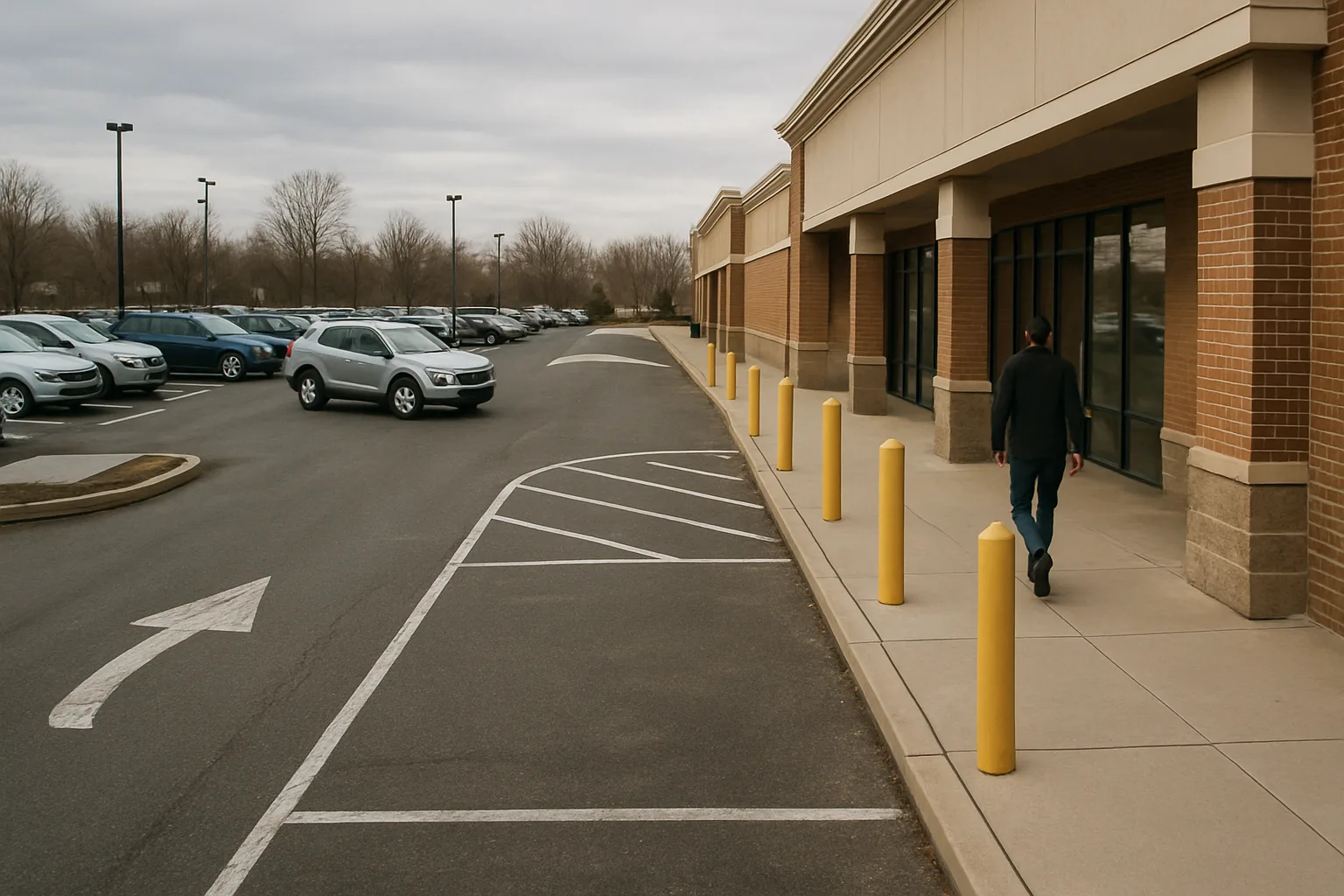
A pedestrian walking from a parking space toward a store may expect vehicles to follow a predictable path. But shopping-center drive aisles often combine turning cars, delivery activity, parking spaces, storefront entrances, and foot traffic in a small area. When a pedestrian is hit, the driver’s actions matter—but the design and maintenance of the property may also deserve careful review.
For someone seeking a Philadelphia shopping center pedestrian accident lawyer, the key question is often broader than “Who was driving?” It may also be whether the property created an unsafe or confusing route for people on foot. Eric A. Shore helps injured people understand how driver conduct, premises conditions, and available evidence may fit together. This article explains what to examine after a collision in a Philadelphia shopping center or New Jersey retail plaza, including crossings, lane markings, barriers, sightlines, nearby businesses, and control of the area.
How a Philadelphia Shopping Center Pedestrian Accident May Involve Traffic Design
Shopping-center roads are usually private drive aisles rather than ordinary public streets, but that does not make their layout irrelevant. A property owner, operator, manager, or other party with control over the premises may have responsibilities that depend on the location, the condition involved, reasonable foreseeability, and what that party knew or should have known. The exact analysis varies under Pennsylvania and New Jersey law.
Design features that can increase pedestrian risk
A review may consider whether:
- Vehicle lanes directed drivers toward storefront doors or pedestrian routes without a clear separation.
- A marked crossing was missing, faded, poorly placed, or difficult to see.
- Landscaping, signs, parked vehicles, dumpsters, columns, or merchandise blocked a driver’s view.
- A curb, bollard, railing, or other barrier was absent where it might reasonably guide vehicles away from walking areas.
- Turning points forced drivers and pedestrians into the same narrow sightline.
- Lighting, pavement contrast, or lane markings made the intended route difficult to understand.
These features do not automatically establish legal fault. They provide issues for investigation. A pedestrian struck in a shopping plaza may have a different claim profile when the collision occurred directly outside a store, at a poorly marked crossing, or where a driveway emptied into a walkway.

Why the property’s control matters
The responsible party may not be obvious. A shopping-center owner, property manager, store tenant, parking operator, maintenance vendor, or another entity may control different portions of the site. A lease, maintenance agreement, site plan, or operating practice may help clarify who was responsible for markings, lighting, traffic flow, snow or debris removal, or barriers. An attorney may evaluate these relationships rather than assuming that the driver is the only potentially relevant party.
Evidence for a Shopping Center Pedestrian Injury Claim
Conditions at a retail property can change quickly. A faded marking may be repainted, a vehicle may leave, a temporary sign may be removed, or surveillance footage may be overwritten. Depending on the circumstances, prompt evidence preservation can help show what the area looked like at the time of the collision.
Useful information may include:
- Wide and close photographs. Images can show the full traffic pattern as well as the specific crossing, curb, obstruction, barrier, or sightline involved. Photograph from a pedestrian’s approach and a driver’s approach when it is safe to do so.
- Video evidence. Nearby stores, banks, restaurants, gas stations, and other businesses may have exterior cameras. Their systems may capture the collision or the surrounding traffic pattern, even if the business was not involved.
- Incident and emergency records. Police reports, 911 information, store incident reports, and communications with property management may identify witnesses, timing, and the initial description of the condition.
- Property records. Site plans, inspection records, maintenance logs, prior complaints, repair requests, and contracts may help show who designed or maintained the area and whether a condition was reported.
- Witness information. Customers, employees, delivery workers, security personnel, and other drivers may have seen the vehicle movement or the visibility problem.
In Philadelphia, the location should be identified carefully. A collision in a privately operated retail lot may involve different property-control questions from one on a public roadway maintained by a city or other governmental entity. In New Jersey, the same general evidence concerns apply, but the governing rules, deadlines, and liability analysis may differ. A qualified attorney can assess the relevant jurisdiction after reviewing the location and facts.
Common Mistakes After a Pedestrian Is Hit in a Retail Plaza
People often focus on immediate medical needs and the driver’s insurance information. Those concerns are important, but other steps and decisions may affect how the incident is later understood. Generally speaking, people should avoid altering or discarding relevant items, posting detailed statements about fault online, or assuming that an informal conversation with a store employee preserves an official record.
Depending on the circumstances, an attorney may advise taking these measures:
- Record the exact shopping-center address, storefront, entrance, drive aisle, and direction of travel.
- Note whether the crossing was marked, whether vehicles were parked nearby, and whether lighting or weather affected visibility.
- Keep contact information for witnesses and identify businesses that may have exterior cameras.
- Preserve photographs, clothing, bicycle or mobility equipment, vehicle information, receipts, and communications related to the incident.
- Avoid guessing about speed, distance, or fault when speaking with insurers or property representatives.
- Seek appropriate medical attention and follow the advice of qualified healthcare professionals without assuming that an early evaluation captures every later symptom.
A potential claim may involve negligence, premises liability, or both, but labels alone do not determine responsibility. The analysis can turn on notice, control, foreseeability, conduct by the driver and pedestrian, the condition of the property, and the evidence available. Pennsylvania and New Jersey also have different rules concerning fault allocation, limitations periods, and claims involving public entities. Because these rules can be outcome-determinative and may change, location-specific legal review is important.
Frequently Asked Questions
Is a shopping-center owner responsible when a car hits a pedestrian?
Not automatically. A driver may be responsible for unsafe driving, while a property owner, operator, tenant, or contractor may be relevant if a dangerous condition or traffic design contributed to the collision. Responsibility depends on facts such as control of the area, notice of the condition, the foreseeability of pedestrian traffic, and whether the condition played a meaningful role. Pennsylvania and New Jersey apply different legal rules, so the location matters.
Can nearby businesses have video of a private property crosswalk accident in Philadelphia?
They may. Stores, restaurants, banks, and other businesses sometimes use exterior cameras that capture drive aisles, entrances, sidewalks, or parking areas. The footage may be held for a limited period and may not be obvious from the collision site. Identifying nearby businesses and asking that potentially relevant footage be preserved can be part of an attorney’s investigation, although preservation does not guarantee that usable video exists.
What if there was no marked crosswalk in the parking lot?
The absence of a painted crosswalk does not by itself answer whether anyone was legally responsible. A review may consider the property’s overall pedestrian route, vehicle flow, storefront placement, visibility, barriers, lighting, and applicable local requirements. It may also consider how the collision occurred and what each person could reasonably see. An attorney can evaluate whether the unmarked route is relevant to a potential claim under Pennsylvania or New Jersey law.
Does a police report decide who is liable for a plaza collision?
A police report can be important evidence, particularly because it may record statements, witnesses, road conditions, and the officer’s observations. However, it generally is not the only evidence used to assess civil responsibility. Photographs, surveillance, medical records, property documents, testimony, and physical measurements may provide additional context or identify conditions not noted at the scene. The report should be reviewed alongside the complete factual record.
How Eric A. Shore Can Help
Eric A. Shore is dedicated to helping injured pedestrians and families examine the full context of a shopping-center collision. The firm can review how the driver moved, how pedestrians were directed, whether crossings and markings were clear, what barriers or obstructions existed, and which parties may have controlled the area. The team is committed to fighting for clients’ rights while explaining the process and evaluating available evidence under the applicable Pennsylvania or New Jersey rules.
If you or a family member was struck in a Philadelphia shopping center or New Jersey retail plaza, contact Eric A. Shore for a free consultation or case evaluation. The firm is ready to evaluate your situation and discuss your legal options.
The information in this article is for educational purposes only and does not constitute legal advice. Contact a qualified attorney licensed in Philadelphia, PA; New Jersey for advice specific to your situation.