By Eric A. Shore, Founding Attorney, Law Offices of Eric A. Shore Last updated: September 2026
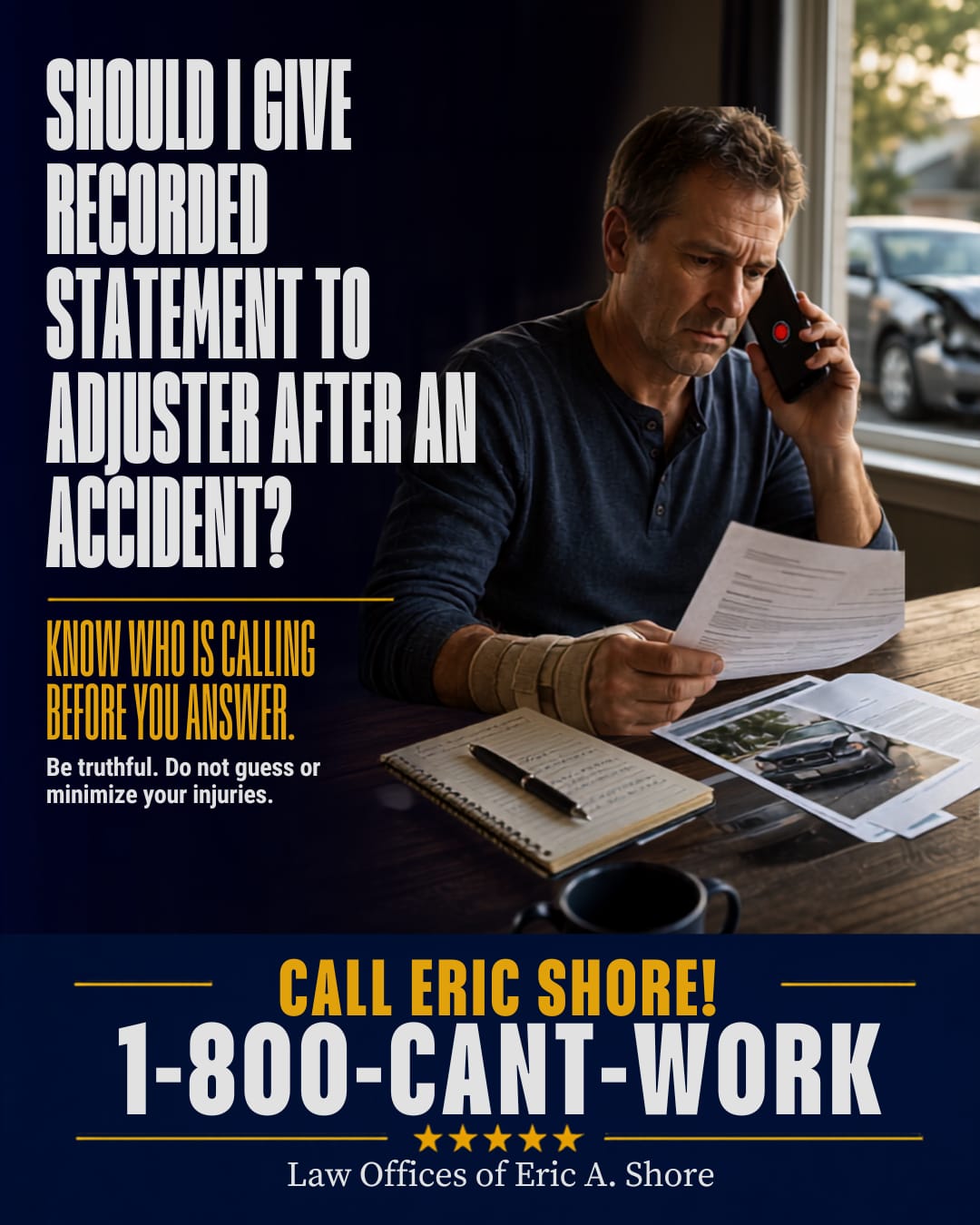
You do not have to give a recorded statement to the other driver’s insurance company. You may have to give one to your own insurance company, because most auto, homeowners, and renters policies require you to cooperate with a reasonable investigation. In both situations, my advice after more than 30 years as an injury and disability lawyer is the same: find out whose insurance company is calling, and talk to your attorney before you answer detailed questions about the accident.
Key Takeaways
- The other driver’s insurer cannot require a recorded statement. You have no contract with that company, and its adjuster works for the other side.
- Your own insurer may require one. Ignoring a legitimate request under your policy’s cooperation clause can create a coverage problem, so do not refuse it, but do not give it unprepared either.
- A recorded statement is evidence. Adjusters compare it against police reports, medical records, and later testimony, and small inconsistencies get used to question your claim.
- If you do not know an answer, say “I don’t know.” Never guess about speed, distance, timing, or how badly you are hurt.
- Speak with an attorney first whenever possible. In Pennsylvania and New Jersey, the Law Offices of Eric A. Shore handles this call for injured clients every week.
What Is a Recorded Statement?
A recorded statement is an interview with an insurance adjuster that is recorded and usually transcribed. The adjuster asks how the accident happened, what you saw, your speed and position, what you said at the scene, when your symptoms started, which parts of your body hurt, whether you had prior injuries or accidents, what treatment you have received, and whether you have missed work.
The problem is timing. The request often comes within hours or days of the accident, before you have seen the police report, looked at photographs, talked to witnesses, or learned the full extent of your injuries. You are being asked to lock in your version of events at the moment you know the least.
Why Does the Insurance Adjuster Want a Recorded Statement?
The adjuster wants a recorded statement because it is the earliest and often the most useful piece of evidence for limiting what the insurance company pays. Insurers do need information to investigate claims, but the adjuster is also measuring the company’s financial exposure, and your recorded words are the yardstick.
Later, every other piece of evidence gets compared against that recording: the police report, your medical records, witness statements, your employment records, prior claims, and your deposition if the case goes into litigation. Adjusters pay particular attention to who caused the accident, whether you were distracted, whether you felt pain right away, which injuries you mentioned, prior injuries to the same body part, gaps in treatment, and your ability to work.
A small difference between the recording and the medical records does not mean anyone is lying. It does mean the adjuster now has something to argue with, and correcting it months later is far harder than getting it right the first time.
Do I Have to Give a Recorded Statement to the Other Driver’s Insurance Company?
No. You have no insurance contract with the other driver’s insurance company, so nothing requires you to give its adjuster a recorded statement. The adjuster can ask, and you can decline or say you want to speak with an attorney first.
If the other driver’s adjuster calls unexpectedly, you can find out what you need to know without discussing the accident at all. Ask which insurance company they are with, whom they represent, whether the call is being recorded, why they want a statement, and what requires you to give one. The honest answer to that last question is usually “nothing.”
Keep one thing in mind throughout the call: the other driver’s adjuster does not represent you and is not evaluating your claim to be fair to you. If you already have an attorney, refer the adjuster to your attorney and end the call.
Do I Have to Give a Recorded Statement to My Own Insurance Company?
Possibly. Your own auto, homeowners, or renters policy almost certainly contains a cooperation clause, which is a promise that you will assist with a reasonable investigation of a claim. Depending on the policy and the type of claim, that can include answering questions or giving a recorded statement.
This matters more in Pennsylvania and New Jersey than many people realize. In both states, PIP coverage generally pays medical expenses after an auto accident regardless of who caused the crash. That means your own company may be involved in your claim from the start, and it may have a legitimate reason to ask questions.
Ignoring a proper request from your own insurer can create a coverage problem, so do not refuse. But a duty to cooperate is not a duty to give an unprepared statement on the spot. Before you give it, find out what part of your policy requires it, what coverage is being investigated, what topics the insurer wants to cover, whether your attorney can be present, and whether you can get a copy of the recording or transcript. Even with your own company, I recommend speaking with your attorney first.
What Should I Say if I Don’t Know the Answer to a Ǫuestion?
Say “I don’t know.” Do not guess about speed, distance, time, the color of a traffic signal, what another driver saw, or anything else you cannot reliably remember.
The rule I give clients is this: “The three most important words in a recorded statement can be ‘I don’t know.’ A guess today can sound like a fact six months from now.” Being truthful and being pressured into an estimate are two different things, and the recording will not capture the difference.
Can Saying “I Felt Fine” Hurt My Injury Claim?
Yes. People often tell the adjuster they were “fine” right after the accident when what they really mean is that they did not yet know how badly they were hurt. Pain, stiffness, headaches, and other symptoms frequently become noticeable only after the shock of the accident wears off, sometimes days later.
Once “I felt fine” is on a recording, the adjuster can use it against every medical record that follows. Do not exaggerate your condition, but do not minimize it either. Describe what you actually experienced, when you first noticed symptoms, and how those symptoms have changed since.
What if I Had an Injury Before the Accident?
Tell the truth about it. A prior injury does not mean your current condition was caused by the old problem. A new accident can aggravate an existing condition or cause a new injury to the same part of the body, and both can potentially be compensable in Pennsylvania and New Jersey.
Do not hide prior treatment, because the adjuster will find it in your records anyway. What you should not do is agree that your condition is “the same as before” if it is not. Explain how you were doing before the accident and what changed afterward.
What if I Don’t Know the Full Extent of My Injuries Yet?
Say that your medical evaluation is still ongoing. Recorded statements are often requested before you have had an MRI, seen a specialist, or received a diagnosis, and the adjuster knows that.
Avoid predicting your medical future. Statements like “my injuries are minor,” “I’ll be fine in a few days,” “I only hurt my neck,” “I’ll be back at work next week,” or “I don’t need any more treatment” can all be used to limit your claim before you know what it is worth.
Describe only what you know at the time.
What if the Adjuster Asks a Misleading Ǫuestion?
Correct the question before you answer it. An adjuster might ask, “When you entered the intersection without looking, what happened?” If you disagree that you entered without looking, say so first, and do not simply answer the rest of the question.
Listen to the whole question, ask for clarification when you need it, and never accept an assumption just because the adjuster built it into the question. On a recording, silence can sound like agreement.
What Should I Do Before Giving a Recorded Statement?
First, confirm whose insurance company is asking and whether you are actually required to participate. If you decide to give a statement, prepare for it like the evidence it is:
- Speak with your attorney first whenever possible.
- Understand why the statement is being requested and what coverage is involved.
- Review the police report and any photographs before the call.
- Think through your symptoms and treatment in order, from the day of the accident forward.
- Be ready to discuss relevant prior injuries truthfully.
- Do not guess, do not exaggerate, and do not minimize your injuries.
- Correct any inaccurate assumption in a question before answering it.
- Ask for a copy of the recording or transcript.
Do not let an unexpected phone call pressure you into discussing every detail of your accident that day. You can schedule the call for a time when you are prepared.
Is a Recorded Statement the Same as an Examination Under Oath?
No. An examination under oath, or EUO, is a more formal process that arises from your own insurance policy. It involves sworn testimony, usually with lawyers present, a court reporter, and requests for documents.
Do not ignore an EUO request. Failing to appear can affect your insurance coverage. If you receive one, have an attorney review it promptly.
What Should I Do When an Insurance Adjuster Calls?
Start with three questions: Who are you? Whom do you represent? Why are you asking for a recorded statement? Then decide whether you actually have an obligation to give one before you discuss the accident in any detail.
If you are hurt and out of work after a car accident in Pennsylvania or New Jersey, the Law Offices of Eric A. Shore can take that call for you and protect your personal injury claim from the start. Call 1-800-CANT-WORK or visit 1800CantWork.com before you give any insurance company a recorded statement.
About Eric A. Shore
Eric A. Shore is the founding attorney of the Law Offices of Eric A. Shore and has been an injury and disability lawyer since 1994. The firm has helped more than 40,000 injured and disabled people with personal injury, disability, workers’ compensation, and employment claims, and its clients have received or are expected to receive over $250 million in judgments, settlements, and estimated lifetime benefits.
This article provides general information and is not legal advice. Whether you are required to provide a statement depends on your insurance policy, the type of claim, the specific facts, and the law that applies.