By Eric A. Shore, Founding Attorney, Law Offices of Eric A. Shore Eric has been an injury and disability lawyer for over 30 years. Last updated: October 2026
Quick Answer
Yes, you may be able to sue. If you or your child tripped over a Halloween decoration, an extension cord, or a fog machine at a home or business, someone responsible for the property may be liable for your injuries.
A fall alone does not make the property owner pay. You generally need to show that someone failed to use reasonable care. For example, they created the danger, or they did not fix it or warn you about it when the law required them to.
Why Do Halloween Decorations Cause So Many Falls?
Most Halloween decorations go up fast. People plug in lights, run a cord to the porch, stake down an inflatable, and move on. They rarely stop to ask where visitors will walk in the dark.
That is the problem. A walkway that is safe every other night of the year becomes a trip hazard on Halloween. And it happens on the one night when the most people, including small children in costumes, walk up to the door after dark.
Which Halloween Decorations Are the Most Dangerous?
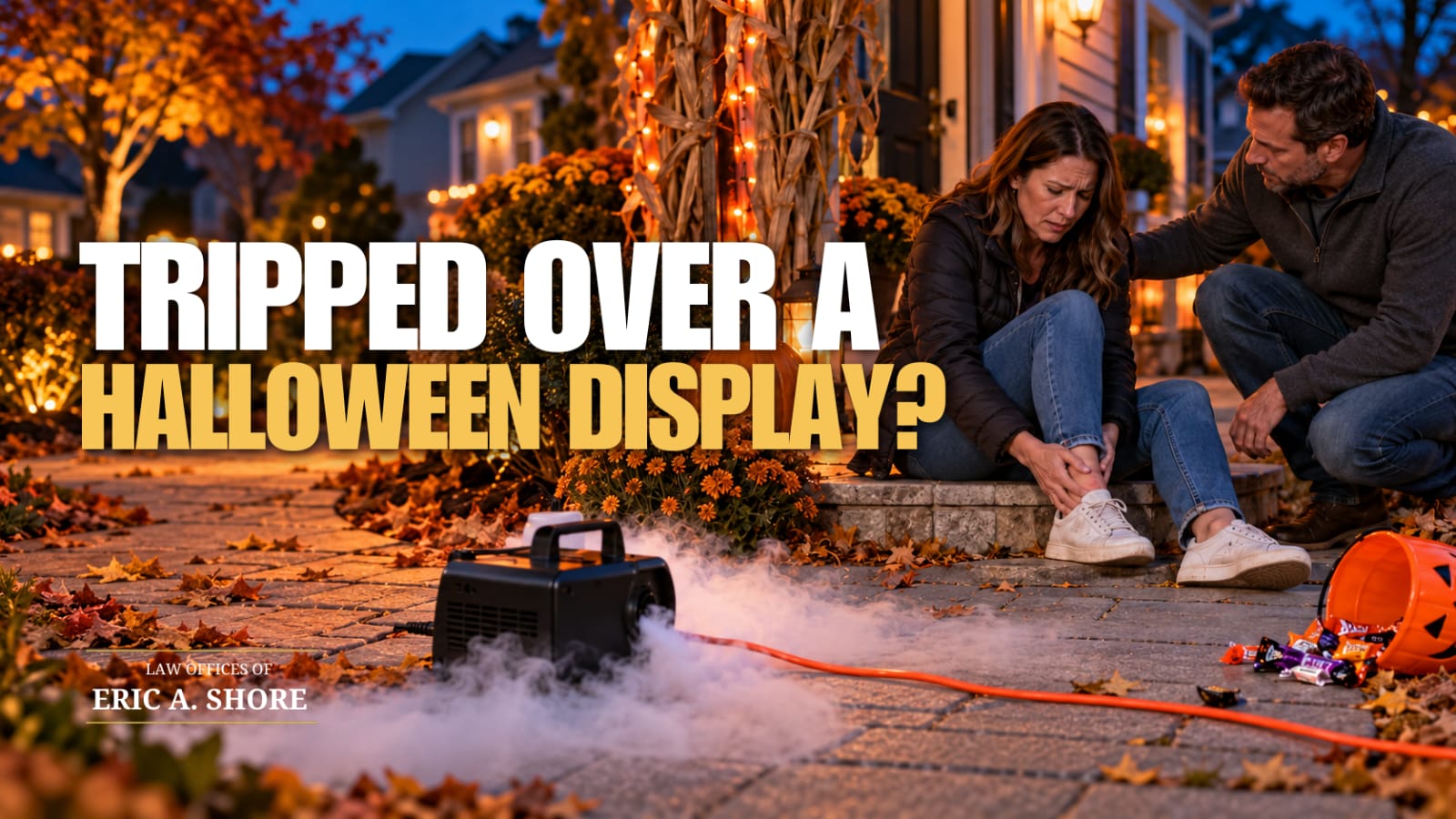
Extension cords. This is the big one. Cords get run across sidewalks, porch steps, and doorways to power lights, inflatables, and fog machines. They are dark, thin, and almost impossible to see at night. Cords pushed under a doormat or loosely taped down can catch a foot just as easily.
Inflatable stakes and tie-down lines. Blow-up decorations are held down with stakes and thin ropes. These lines often stretch across the lawn or into the path. A stake left sticking up can also cause a bad fall.
Fog machines. Fog hides steps, curbs, and anything on the ground. Some fog fluids can also leave the ground wet or slick.
Dim, flashing, or strobe lights. Spooky lighting makes it hard to judge steps and uneven ground. Strobe lights can make it hard to see at all.
Props on steps and porches. Pumpkins, hay bales, gravestones, and figures placed on stairs narrow the walking space. People step around them and miss a step.
Jump-scare decorations. Motion-activated props that lunge or scream can make someone jump back and fall, especially on stairs.
What if You Fell at a Store or Business?
Businesses generally must use reasonable care to keep the areas customers use reasonably safe. That includes entrances, aisles, and parking areas. A store that puts up a Halloween display must take reasonable steps so the display does not create a danger for customers.
If a store employee ran a cord across the entrance, the store created the danger. In that case, you generally do not have to prove the store was warned about the hazard before you fell. It is different if a decoration blew into the path on its own. Then you may need to show the store knew about it or should have found it with reasonable care.
What if Your Child Was Hurt While Trick-or-Treating?
Homeowners have duties too, but they are not always the same as a store’s. The law looks at why the person was on the property, whether they were invited, and what the owner knew or should have known. Depending on the state, a homeowner may have to warn guests about hidden dangers or take reasonable steps to keep the areas guests use safe.
Not every trick-or-treating fall leads to a case. But a family that decorates and invites children up to the door should not leave a hidden cord or stake in their path. Cords in the dark, hidden steps, and fog over stairs are all worth a closer look.
Can You Still Sue if You Should Have Seen It?
Often, yes. The insurance company may argue that you should have watched where you were going. That does not necessarily end your claim.
In most states, your own share of the blame lowers your money but does not always wipe out your case. The rules differ from state to state, and some are stricter than others.
Young children are not necessarily held to the same standard as adults. And a cord that is easy to see in daylight can be hard to notice at night in fog and flashing lights.
What Should You Do Right After the Fall?
Halloween decorations often come down the next day, and the proof can disappear with them. Act fast.
- Get medical care first. Falls can cause broken bones and head injuries that are not obvious right away.
- Take photos of the exact spot before anything is moved. Get close photos of the cord or decoration and wide photos of the whole path.
- Show how dark it was. If you can, take photos or video under the same lighting.
- Get the names and phone numbers of anyone who saw the fall.
- Look for doorbell or security cameras nearby. Ask the owner to save the video.
- Keep the shoes and clothes you were wearing.
- Do not give a recorded statement to an insurance company before getting legal advice.
Who Pays for Your Injuries?
Homeowners, renters, or business liability insurance may cover the injury. But coverage is not guaranteed, and the property owner could be personally responsible.
A claim may cover medical bills, lost pay, pain and suffering, and other losses the law allows. How much depends on how badly you were hurt, who was at fault, and the law that applies.
Hurt by Halloween Decorations?
After more than 30 years of helping injured people, I know small details can make or break a case. Who put the cord there? Was it taped down? Was the path lit? These are the questions we look into first.
If you or your child was seriously hurt by a Halloween decoration, the Law Offices of Eric A. Shore can review what happened. We will tell you whether our firm can help or whether a lawyer licensed in your state would need to handle your case.
The consultation is free. Call 1-800-CANT-WORK.
Learn more about our premises liability cases.
This article provides general legal information and is not legal advice. The outcome of any claim depends on the facts, the law where you were hurt, and the available evidence.