A motorcycle crash can leave more than visible damage. The position of the bike, condition of the road, rider’s protective equipment, witness accounts, and medical records may all become important when fault or the seriousness of an injury is disputed. Understanding New Jersey motorcycle accident evidence early can help preserve details that may otherwise be lost.
For an overview of the firm’s practice, see New Jersey motorcycle accident legal guidance. Eric A. Shore helps injured people understand how physical, digital, medical, and insurance records may fit together. This article explains what to preserve, how common evidence is evaluated, and why riders should avoid premature repairs or disposal of crash-related items.
Which New Jersey Motorcycle Accident Evidence Should You Preserve First?
The most useful evidence often comes from the scene and the damaged motorcycle. Road conditions can change, vehicles can be repaired, and memories can become less precise. If it is reasonably safe and medically appropriate, photographs should show the entire roadway as well as close views of the motorcycle, other vehicles, debris, skid marks, lane markings, traffic controls, lighting, and surface conditions.
Preserve the motorcycle, helmet, and riding gear
Do not repair, sell, discard, or substantially alter the motorcycle before its condition has been documented. Damage patterns may help a qualified professional evaluate the direction and force of impact, points of contact, and whether the physical evidence is consistent with the accounts being given. The motorcycle may also contain relevant accessories, mirrors, lighting equipment, luggage, or camera mounts.
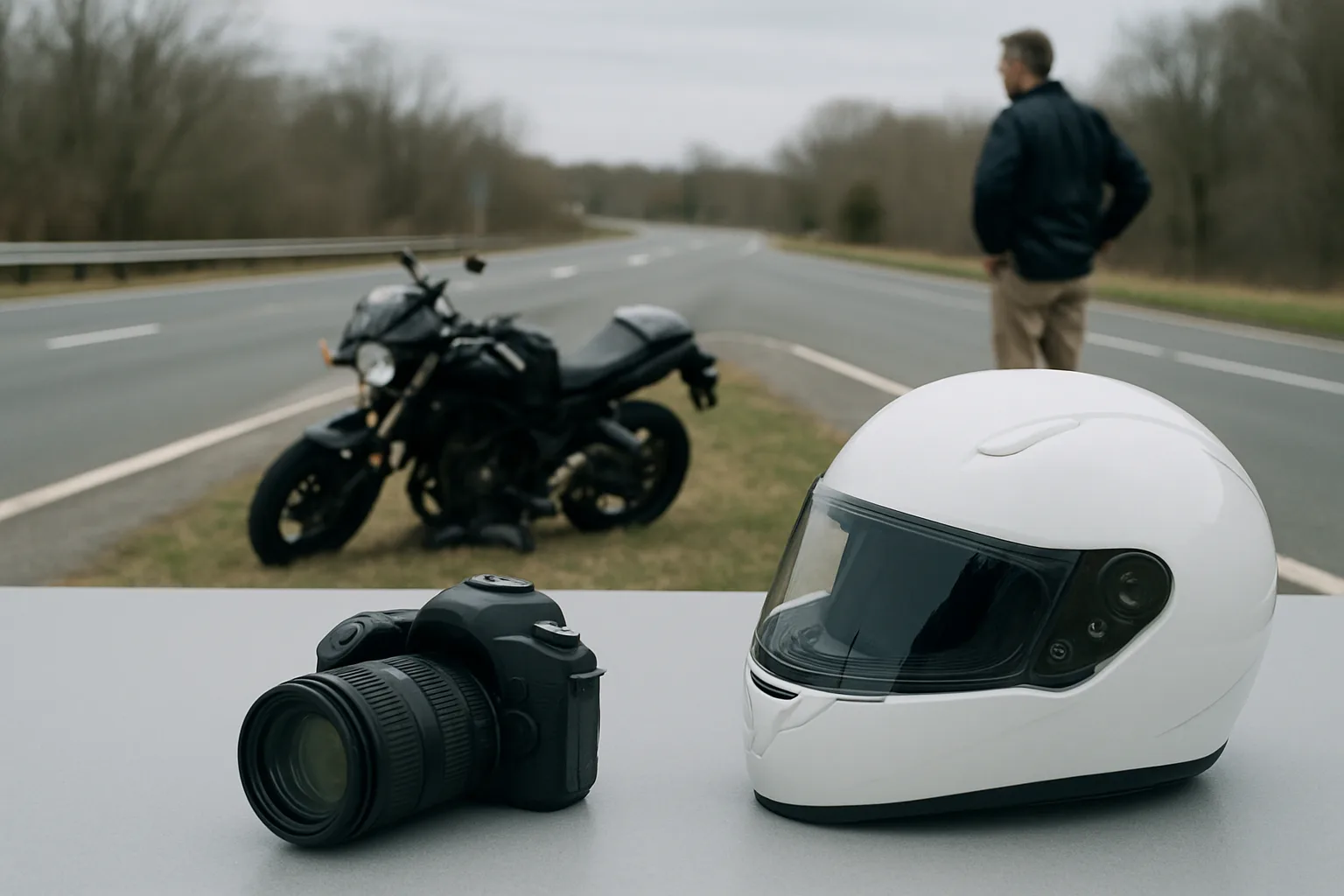
Keep the helmet, jacket, gloves, boots, and other protective equipment in their post-crash condition. Helmet evidence in a motorcycle accident may help show contact or impact, but it does not by itself establish who caused the collision or determine the full extent of an injury. Store these items safely and avoid cleaning or discarding them unless a qualified professional advises otherwise.
New Jersey motorcycle accident legal guidance can provide additional context about preserving evidence and evaluating a motorcycle claim.
How Do Photos, Records, and Witnesses Clarify a Motorcycle Crash?
A strong evidence file usually combines physical proof with independent accounts. No single photograph, police report, or witness statement necessarily answers every question. Instead, an attorney or accident-reconstruction professional may compare different sources to assess visibility, lane position, timing, speed, road design, and the sequence of impact.
Photograph the roadway and document digital evidence
Useful photographs may include:
- The motorcycle and other vehicles from multiple angles
- Damage, broken parts, debris, fluid, skid marks, and tire tracks
- Potholes, uneven pavement, gravel, construction conditions, or standing water
- Signs, signals, sightlines, parked vehicles, vegetation, and lighting
- The rider’s helmet and protective gear before alteration
Nearby businesses, residences, traffic systems, helmet cameras, dashboard cameras, emergency calls, and mobile-device data may also contain relevant information. Video can be overwritten, and original electronic files may include information about when and how they were created. Preserve original files, avoid editing them, and record who provided each item. The firm’s discussion of New Jersey crash digital evidence explains why electronic records can matter even when the underlying collision involves a motorcycle.
Identify witnesses and review the crash report
Write down witness names and contact information as soon as possible, along with what each person observed. A witness who saw the motorcycle before impact may have information about lane position, visibility, turn signals, traffic flow, or whether another vehicle entered the rider’s path. Witness accounts should be preserved accurately rather than shaped to support a preferred version of events.
A police report may list involved drivers, reported conditions, diagrams, citations, and witness information. It is not necessarily the final word on liability, and it may contain errors or incomplete observations. The New Jersey accident report guide describes how reports can be obtained and reviewed alongside photographs, witness accounts, and physical evidence.
What Mistakes Can Weaken Motorcycle Injury Claim Proof?
Motorcycle cases may involve disputed allegations about speeding, visibility, lane position, rider training, or protective equipment. A rider’s training history or licensing information may be relevant to some questions, but it does not automatically prove that the rider caused a particular crash. Likewise, an allegation of speeding should be tested against physical evidence, vehicle damage, witness accounts, video, roadway conditions, and any available reconstruction—not accepted solely because it appears in an early account.
Medical documentation is another important part of motorcycle injury claim proof. Keep emergency records, treatment notes, diagnostic reports, bills, work-loss documentation, prescriptions, and appointment information. Records can help show the timing of symptoms, the nature of treatment, and how the claimed injuries relate to the crash, although medical questions require appropriate medical professionals.
Insurance communications should also be organized. Save policy declarations, claim numbers, letters, emails, text messages, bills, explanation-of-benefits documents, and notes recording calls with adjusters. Your own insurer may pay certain medical bills even when you believe another driver caused the collision. This resource explains why your insurance may pay motorcycle crash medical bills.
Generally, avoid giving a detailed recorded statement, speculating about speed, admitting fault, or minimizing symptoms before you understand what is being asked and how the information may be used. In a hit-and-run or low-coverage collision, policy language and notice requirements may also matter. Information about New Jersey uninsured and underinsured crash claims can help explain why coverage records should be preserved.
Practical preservation checklist
Depending on the circumstances, a rider may consider organizing:
- Scene photographs, videos, and original digital files.
- The motorcycle, helmet, clothing, and other gear.
- Witness names, contact information, and brief factual observations.
- Police, emergency-response, towing, and vehicle-storage records.
- Medical records, bills, work-related documentation, and appointment notes.
- Insurance policies, claim correspondence, recorded-statement requests, and call logs.
Because evidence and deadlines vary, a New Jersey motorcycle accident lawyer may need to assess the specific facts, available coverage, and condition of the evidence before advising on next steps.
Frequently Asked Questions
Does a damaged helmet prove another driver caused my motorcycle crash?
No. A damaged helmet may help document contact, impact direction, or the seriousness of an event, but it generally does not establish fault on its own. Its significance depends on other evidence, such as vehicle damage, roadway photographs, witness accounts, medical records, and video. Preserve the helmet in its post-crash condition and allow a qualified attorney or professional to evaluate how it fits with the broader evidence.
Can a motorcycle accident reconstruction examine an alleged speeding claim?
It may be able to. In New Jersey, reconstruction can involve reviewing photographs, vehicle damage, roadway measurements, video, event data when available, witness accounts, and other physical evidence. A reconstruction opinion depends on the quality of the available information and the specific collision. An allegation in a report or insurance communication is not necessarily a complete analysis of speed or causation.
Should I repair my motorcycle before an insurance inspection?
Repairs may be necessary for safety or practical reasons, but premature work can change or destroy evidence relevant to how the crash occurred. When possible, document the motorcycle thoroughly and preserve damaged parts before repairs or disposal. Storage, towing, and inspection issues can vary, so a New Jersey attorney may help evaluate the appropriate preservation steps for the circumstances. For additional context on this issue, see Best Steps After Motorcycle Crash: Protect Yourself.
What if the other driver left before I could obtain insurance information?
Preserve the scene photographs, emergency records, witness contacts, video, police information, and every communication with insurers. Your available options may depend on whether the driver is identified and on the terms of applicable policies, including uninsured or underinsured motorist coverage. Prompt notice requirements can apply, so a licensed New Jersey attorney can explain the issues specific to your situation.
How Eric A. Shore Can Help
Eric A. Shore is dedicated to helping injured riders organize the evidence that may matter in a New Jersey motorcycle crash claim. The firm can review the motorcycle’s condition, helmet and gear, photographs, witness information, police materials, medical documentation, and insurance communications as part of evaluating the available facts. The team is committed to fighting for clients’ rights while explaining the process in clear, practical terms. Contact Eric A. Shore for a free consultation or case evaluation to discuss your situation and explore your legal options.
The information in this article is for educational purposes only and does not constitute legal advice. Contact a qualified attorney licensed in New Jersey for advice specific to your situation.