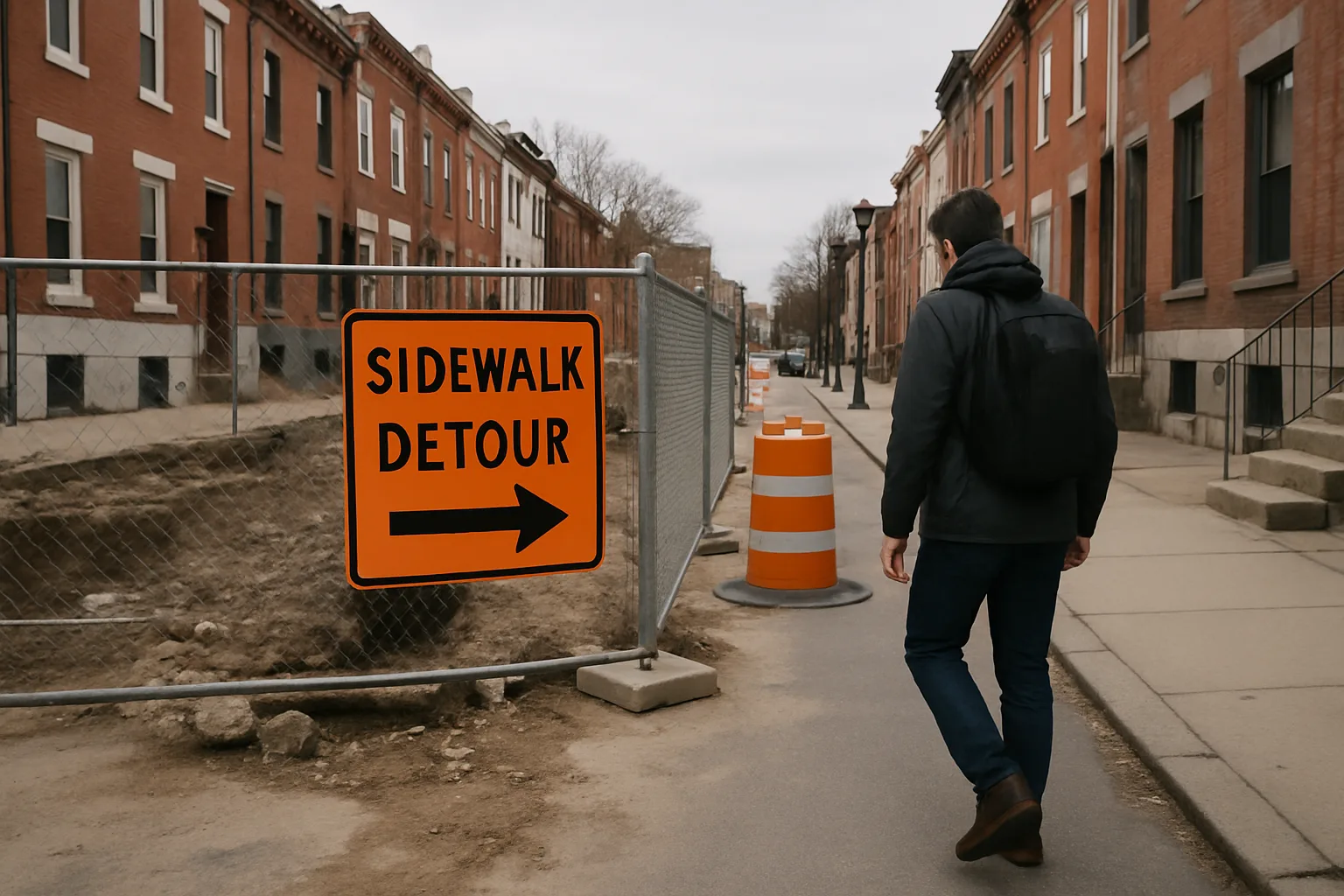
A sidewalk closure can turn a familiar Philadelphia walk into an obstacle course. A pedestrian may encounter a missing barrier, an uneven temporary surface, unclear signs, poor lighting, or a detour that unexpectedly directs people toward moving traffic. If you were hurt, you may be asking: Were You Hurt by a Philadelphia Construction-Zone Pedestrian Detour? The answer may depend on who controlled the route, what warnings were provided, and whether the condition was documented before construction changed.
Eric A. Shore helps injured people understand the issues that can arise in premises liability and personal injury matters. This article explains how to identify potentially responsible parties, photograph the original route and detour, report the condition, obtain medical care, and preserve evidence. For a related discussion of blocked access points, see Philadelphia blocked curb ramp injury claims.
How Can a Philadelphia Construction-Zone Pedestrian Detour Cause an Injury?
Construction does not automatically mean someone is legally responsible for every fall or collision. The important question is often whether the temporary route was reasonably safe under the circumstances and whether the people or entities controlling the work took appropriate precautions.
Common detour hazards
A construction-zone pedestrian injury in Philadelphia may involve:
- A sidewalk or crosswalk blocked without a clear alternate route.
- Barriers, cones, or fencing that leave an opening or direct pedestrians into a hazardous area.
- Uneven plates, temporary ramps, loose gravel, debris, mud, or abrupt changes in elevation.
- Signs that are missing, hidden, inconsistent, or positioned too late for a pedestrian to react safely.
- A detour that lacks an accessible route or forces people to cross where visibility is limited.
- Construction equipment, parked vehicles, or materials that block the pedestrian path or sightline.
An injury might occur during a trip and fall, a collision with a vehicle, or an attempt to move around a barrier. A blocked curb ramp can be especially important when it forces a person toward uneven pavement, traffic, or another route that is not reasonably accessible.
Who may have controlled the area?
Depending on the facts, an investigation may examine the property owner, general contractor, subcontractor, traffic-control company, utility company, or a public entity responsible for part of the right-of-way. The entity that owns land is not always the entity that designed, installed, inspected, or maintained the detour. Understanding who may handle a Philadelphia sidewalk accident claim can help frame the responsibility question without assuming fault before the evidence is reviewed.
What Evidence Matters After a Philadelphia Construction-Site Pedestrian Injury?
Construction conditions can change quickly. A barrier may be moved, a hole may be filled, a sign may be replaced, or a different phase of work may make the original route difficult to recognize. Prompt documentation can help preserve what the pedestrian encountered, but safety should come first.
Photograph the original route and detour
If it is safe and physically possible, photographs may show the full path rather than only the exact place where contact or a fall occurred. Useful images may include:
- The approach to the closed sidewalk or crossing.
- Detour signs, barriers, fencing, cones, plates, ramps, and surface changes.
- The view from a pedestrian’s direction of travel, including blocked sightlines and lighting.
- Nearby intersections, buildings, traffic lanes, and landmarks that establish location.
- Measurements or scale references for gaps, height changes, or narrow passages, when doing so does not create another hazard.
A short written account can also record the date, approximate time, weather, lighting, route taken, warnings seen, and names or contact information for witnesses. The best evidence for a Philadelphia injury claim may include photographs, medical records, incident reports, witness information, and documents showing how the condition affected work or daily activities.
Report the condition and preserve records
A pedestrian may report the incident to the site representative, property manager, or appropriate public authority, depending on where it occurred. Ask how the report will be recorded and keep any confirmation or reference information. Avoid guessing about fault in the report; describe what happened and what the route looked like.
Medical evaluation can create a contemporaneous record of reported symptoms and the connection to the incident. Records may also help document follow-up care, restrictions, missed work, and other effects. In Philadelphia, information held by a contractor, property owner, or public agency may be important, but access and preservation issues can vary by the type of site and claim. For additional context on this issue, see What should I do immediately after a pedestrian accident in Philadelphia?.
What Mistakes Can Weaken an Unsafe Pedestrian Detour Claim?
People injured in a construction area often face questions about whether they saw a warning, crossed outside the suggested route, or could have taken another path. Those questions do not resolve the claim by themselves. Pennsylvania fault rules can involve a fact-specific comparison of the conduct of each party, and the effect of any assigned fault may depend on the circumstances and applicable law.
Do not assume a warning ends the inquiry
A sign may be present but obscured, too small, placed after a decision point, or inconsistent with the physical route. A pedestrian may also have difficulty seeing a sign because of darkness, construction equipment, traffic, or competing signs. Conditions involving crossing locations, sightlines, lane changes, and traffic warnings may make Philadelphia crosswalk design and pedestrian injury claims relevant to the investigation.
Avoid these common evidence problems
- Waiting too long to photograph the route because construction may progress.
- Posting detailed statements or photographs publicly before understanding the claim.
- Failing to identify witnesses, nearby businesses, or possible camera locations.
- Discarding shoes, clothing, mobility aids, or other items involved in the incident before they are documented, when preserving them is reasonably possible.
- Assuming the construction company is the only potentially responsible party.
- Missing communications, medical appointments, work records, or receipts that help show the injury’s effects.
An injured pedestrian may also worry that stepping around a barrier or missing a sign automatically eliminates a claim. Pennsylvania pedestrian accident comparative fault may be relevant, but responsibility generally depends on the full route, the warnings, the visibility, and the choices reasonably available at the time.
Frequently Asked Questions
Can I bring a claim if the construction detour had a warning sign?
Possibly. A warning sign is one fact, not necessarily the entire safety analysis. Its placement, visibility, wording, timing, and consistency with the actual route may matter. Investigators may also examine whether barriers, lighting, surface conditions, and crossing arrangements created a separate hazard. Under Pennsylvania law, the result can depend on the evidence and the conduct of all involved parties. A qualified attorney can review the specific site conditions.
What if I did not take a picture immediately after the accident?
A claim is not necessarily defeated because photographs were not taken at once. Other evidence may include later photographs, witness accounts, medical records, incident reports, surveillance footage, construction schedules, inspection materials, and messages exchanged with site representatives. It can be useful to write down what you remember while the details are fresh, including the route, warnings, lighting, and surface condition. Evidence may be harder to obtain as work progresses.
Does the City of Philadelphia always pay for a construction-zone injury?
No. The identity of a potentially responsible party depends on ownership, control, maintenance duties, permits, construction contracts, and the location of the route. A private developer, contractor, utility, property owner, or public entity may have different responsibilities. Claims involving public property can also involve special procedural requirements and defenses. Because Pennsylvania and Philadelphia rules may vary by claim type and may change, legal review should be based on the specific facts.
How long do I have to evaluate a detour injury claim?
Deadlines can depend on the legal theory, the identity of the defendant, the claimant’s circumstances, and whether a public entity is involved. Evidence-preservation concerns may arise well before a filing deadline because construction conditions can disappear. Rather than relying on a general time estimate, a pedestrian may discuss the incident promptly with a licensed attorney who can assess potentially applicable Pennsylvania deadlines and notice requirements.
How Eric A. Shore Can Help
Eric A. Shore is dedicated to helping injured pedestrians evaluate construction-zone and premises liability concerns in Philadelphia, PA. The firm can review how the detour was designed and maintained, identify entities that may have controlled the area, assess available photographs and records, and consider medical and financial documentation. Counsel may also help preserve evidence and address arguments concerning warnings or comparative fault.
If you are looking for Philadelphia personal injury lawyer help, the firm is committed to fighting for your rights while explaining your legal options. Contact Eric A. Shore for a free consultation or case evaluation regarding your construction-zone pedestrian injury.
The information in this article is for educational purposes only and does not constitute legal advice. Contact a qualified attorney licensed in Philadelphia, PA for advice specific to your situation.